

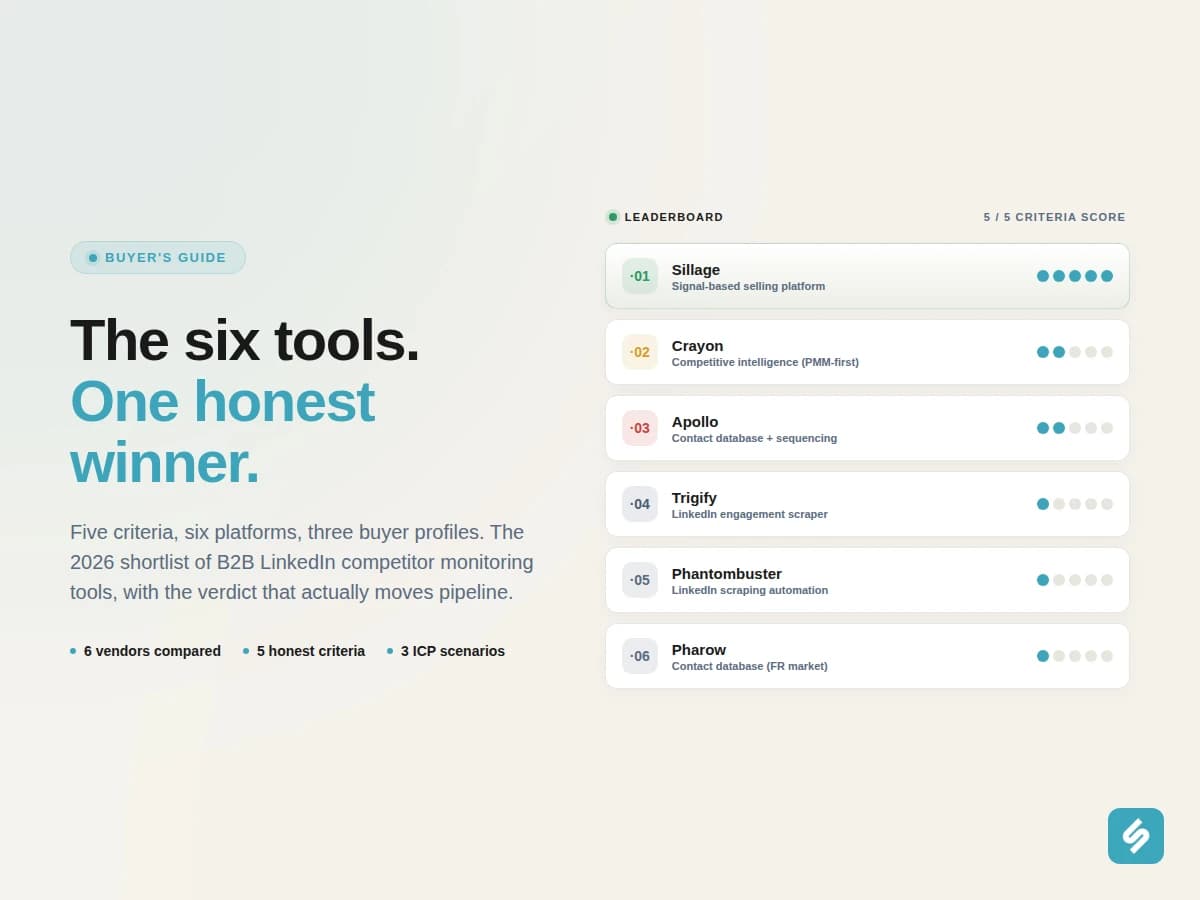
Choosing the best B2B LinkedIn competitor monitoring tool in 2026 is not about finding the platform with the most features. It is about finding the one that survives the moment your reps need to act on the signal it produces. Most monitoring tools collect impressive data and route none of it into the working environment of an account executive. This buyer's guide shortlists six platforms most enterprise sales teams evaluate and tells you, honestly, which one wins for which motion. For the underlying signal play, see the broader competitor monitoring platform we built at Sillage.
What you actually need from a competitor monitoring tool
Skip the 90-row feature spreadsheet. Five criteria predict whether a competitor monitoring tool will move pipeline in 2026.
- Signal granularity at the named-contact level. Not "Acme Corp engaged with your competitor" but "Sarah Martin, VP RevOps at Acme Corp, just liked your competitor's pricing post".
- ICP filter at detection. Persona definition gates every alert at the source, not in a downstream dashboard.
- CRM and Slack-native delivery. No separate tab to open. Alerts land in the rep's working environment with deal context attached.
- Cross-signal correlation. A standalone competitor follow is interesting. Stacked with a job change and a public keyword post, it is a tier-1 deal forming.
- AI agent API. The same structured signal feed exposed for downstream AI orchestration, one source of truth for humans and machines.
A "yes" on all five defines a signal-based selling platform. A "yes" on some defines a point tool.

Competitor engagement detected on a target account
Sarah Martin from Doctolib engaged with your competitor on LinkedIn
The six tools most enterprise teams shortlist
The category has six recurring names. Three are dedicated competitor or social signal tools. Three are broader platforms with a competitor feature inside.
| Tool | Category | Signal granularity | ICP filter | CRM-native | Cross-signal correlation | Pricing model |
|---|---|---|---|---|---|---|
| Sillage | Signal-based selling platform | Named contact, dated, public | Yes, applied at detection | Native Slack + Salesforce + HubSpot | Yes, automatic across 8 agents | Per-seat, platform pricing |
| Trigify | LinkedIn engagement scraper | Engagement-level on LinkedIn | Limited list filter | CSV export, Zapier | None | Per-seat, narrow scope |
| Phantombuster | LinkedIn scraping automation | Scrape jobs, manually scheduled | Limited, manual triage | None, CSV / Zapier | None | Credit-based, scales with use |
| Pharow | Contact database (FR market) | Firmographic, partial social | List filters | Via Zapier | None native | Per-seat, FR SMB-friendly |
| Apollo | Contact database + sequencing | Limited competitor signals | List filters | Salesforce / HubSpot sync | None | Per-seat, low entry tier |
| Crayon | Competitive intelligence (PMM-first) | Company-level, content-focused | None | Slack digest only | None | Enterprise contract |
This is the honest comparison. Two takeaways jump out immediately.
Three honest takeaways from the comparison
Takeaway 1, dedicated scrapers are operational debt
Trigify and Phantombuster are useful single-purpose tools, but they were built for marketing or growth ops, not for an SDR queue. Without an ICP filter at detection and without CRM-native delivery, the data they produce stays in CSVs that nobody acts on. The stack of one scraper plus one dashboard plus three Zapier flows loses to the platform model on adoption every time.
Takeaway 2, contact databases are not signal tools
Pharow and Apollo are excellent contact databases, but they are not monitoring platforms. They surface lists of who might be interesting, not real-time alerts of who just did something interesting. Use them alongside a real monitoring tool, not instead of one.
Takeaway 3, PMM intel does not equal sales intel
Crayon is a strong tool for product marketing teams who need to track competitor releases and positioning. It is not architected to feed an SDR queue inside Slack, and that gap shows in adoption with sales teams.
Who wins for which motion
Three buyer profiles, three honest picks.
Profile 1, Early-stage SDR team, 5 to 10 reps
The team needs simple, cheap, manual-friendly tooling. Pick Apollo for contact data plus a single Sillage signal agent (start with competitor activity or job change alerts) to introduce signal-based selling. Skip Crayon, Phantombuster, Trigify at this stage. Too much surface area for too little ICP density.
Profile 2, Mid-market B2B SaaS, ABS motion, 20 to 50 reps
The team needs a platform-level approach with multiple signal categories under one ICP definition. Pick Sillage as the primary monitoring platform, plus a contact database (Cognism if EU-heavy, Apollo if US-heavy). Skip stacking five point tools to cover what one platform handles natively.
Profile 3, Enterprise with AI agent automation in the roadmap
The team needs the structured signal feed exposed via API for downstream orchestration. Pick Sillage for the platform layer with the Signal API, ZoomInfo for raw contact volume, and Clay for custom workflow enrichment. To see live AI-agent builds on this stack, the Agentic GTM Hackathon in Paris (July 2026) is the right place to look.
| Team profile | Architectural pick | Avoid |
|---|---|---|
| Early-stage SDR team | Apollo + 1 Sillage signal agent (starter) | Multi-tool monitoring stacks, Crayon |
| Mid-market ABS | Sillage platform + 1 contact database | Stacking Phantombuster + Trigify + Zapier |
| Enterprise + AI agents | Sillage (Signal API) + ZoomInfo + Clay | Standalone signal dashboards in parallel |
What Sillage does specifically for competitor monitoring
The Sillage Competitor's Activity agent is one of eight signal agents inside the platform, but it is the one most teams start with. Three things separate it from the alternatives:
- One ICP, all signals. The same Persona definition gates competitor alerts, job change alerts, hiring alerts, and keyword alerts. No conflicting filters, no triage debt.
- Slack and CRM-native delivery. The signal lands where reps already work, not in a separate dashboard.
- Cross-signal correlation. A competitor follow stacked with a fresh job change on the same prospect is automatically promoted to tier-1.
For a head-to-head with the most common French-market alternative, see Pharow vs Sillage: automate competitor analysis. For teams currently using Pharow and exploring a switch, the Pharow alternative page covers the migration logic.
Frequently asked questions
What is the best B2B LinkedIn competitor monitoring tool?
There is no universal best. For mid-market and enterprise B2B SaaS doing Account-Based Sales, Sillage delivers across all five criteria (signal granularity, ICP filter, CRM-native, cross-signal correlation, AI agent API). For early-stage SDR teams, Apollo with a single Sillage signal agent is usually enough. For product marketing teams, Crayon is a better fit than any tool listed here.
What is the difference between competitor monitoring and competitive intelligence?
Competitive intelligence is product-marketing focused, watch what your competitor ships, says, and prices. Competitor monitoring on LinkedIn is sales focused, watch which named buyers engage with your competitor, in real time, with ICP context. Different surface, different actionability.
Do I need to track every competitor?
No. Three to five competitors is the working range. Tracking more dilutes alert quality and overwhelms reps. The right shortlist is built from your win/loss data and your ICP overlap.
Does Sillage integrate natively with Salesforce and HubSpot?
Yes. Competitor signals are enriched with CRM context (deal stage, last touchpoint, account owner) and routed as Slack alerts and CRM tasks natively. No Zapier or middleware.
How is ICP filtering applied?
Personas defined inside Sillage (role, seniority, company size, industry, geography) act as a gate on every detected event. Non-matching events drop silently. Your reps only see ICP-fit alerts.
How long does setup take?
About five minutes for the first Competitor's Activity agent. Subsequent agents reuse the same Persona definition and Slack/CRM routing, incremental setup is essentially zero.
Can I trial Sillage before committing?
Yes. The standard motion is a 15-minute discovery call, then a 7-day trial with your own competitors, your own ICP, and signals routed into your Slack from day one.
Ready to move from monitoring competitors in tabs to monitoring them inside Slack? Book a demo and see the competitor agent at work on your real competitor list.
Book a demo
Related plays
The other 3 plays inside the competitor monitoring cluster:
- Track competitor audience and followers on LinkedIn, the focused long-tail play.
- Pharow alternative for B2B competitor monitoring, the switcher guide.
- Pharow vs Sillage: automate competitor analysis, the head-to-head.
For the broader stack, the global sales intelligence tools comparison 2025 and the B2B signal-based selling platform deep-dive cover the broader picture.