


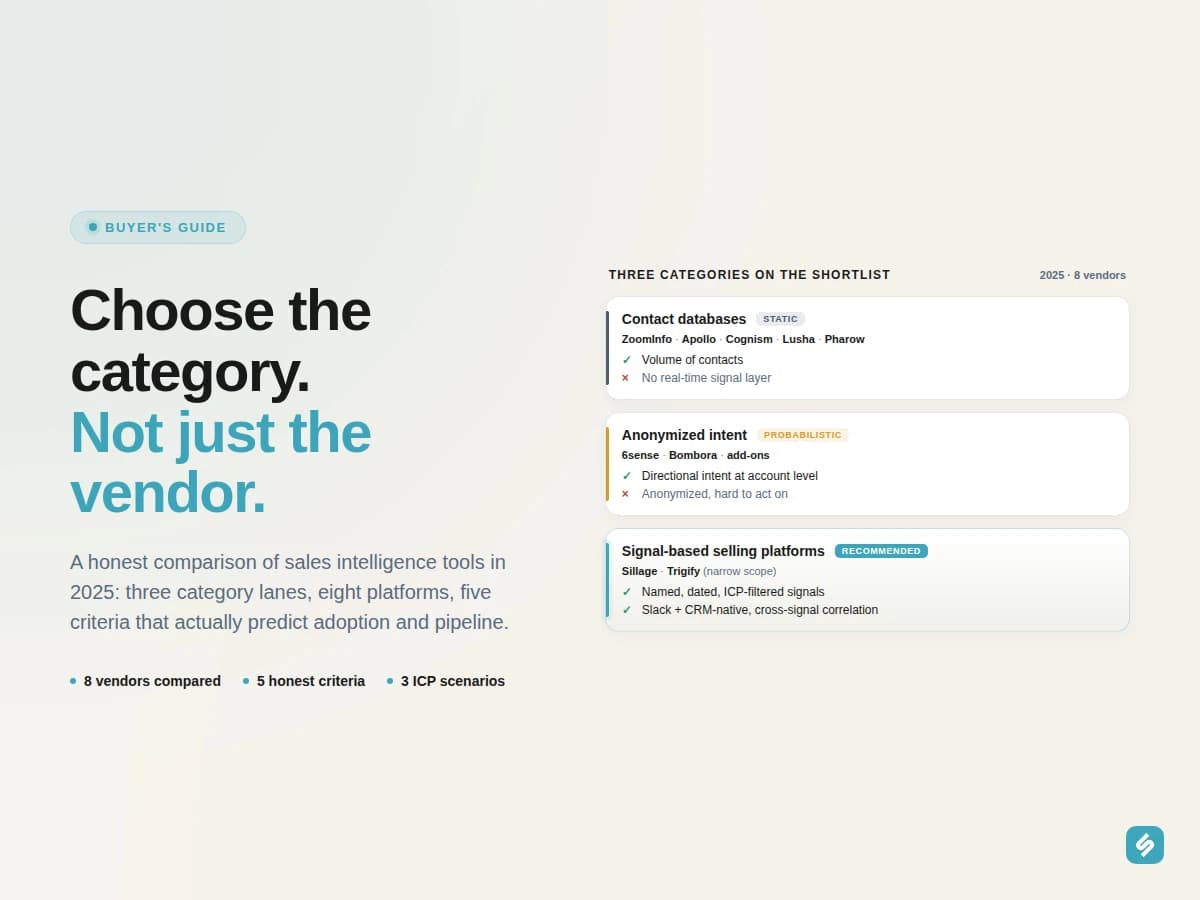
A serious sales intelligence tools comparison in 2026 is not a Top-10 listicle, it is a decision framework. The category has split into three lanes (contact databases, anonymized intent platforms, signal-based selling platforms), each solving a different problem, each priced and adopted differently. This page is the buyer's-guide-style comparison of the nine platforms most enterprise B2B sales teams shortlist: ZoomInfo, Apollo, Clay, Cognism, Lusha, Pharow, Zeliq, Trigify and Sillage, by signal coverage, integration depth, ICP filtering, adoption realism, and pricing model.
What "sales intelligence" actually means in 2026
The label "sales intelligence" covers three structurally different product categories that are often confused on shortlists.
- Contact databases, large repositories of B2B contacts and firmographics. The category that ZoomInfo, Cognism, Apollo and Lusha originated in. Strength: coverage. Weakness: the data is static the moment you export it.
- Anonymized intent platforms, third-party data co-ops surfacing account-level "research signals" (e.g. "Acme Corp is researching CRM solutions this week"). Strength: directional intent. Weakness: account-level, probabilistic, requires building a downstream workflow.
- Signal-based selling platforms, the newer category that monitors public, named, dated signals (LinkedIn engagement, job changes, hiring patterns, keyword posts, KOL audiences, competitor activity, account events) per ICP, native to Slack and CRM. Sillage is in this category; see our overview of the B2B signal-based selling platform for the deep dive.
A serious shortlist needs at least one tool per category, or, increasingly, one platform that does the signal-based layer well and a complementary contact source. Mixing two contact databases is operational debt.

Multi-signal stack on a target account
Sarah Martin from Doctolib engaged with your competitor on LinkedIn
The honest five-criteria comparison framework
Forget feature checklists with 90 rows. The five criteria that actually predict whether a sales intelligence tool will move pipeline in 2026 are:
- Signal coverage, how many distinct, named, dated buying signals does the tool surface? (Contact data alone = zero signals.)
- ICP filter at the source, does the tool apply your Persona definition before alerts reach reps, or do you triage the firehose yourself?
- CRM and Slack native, does the tool live where reps work, or in its own dashboard nobody opens?
- Cross-signal correlation, can the tool stack two or three signals on the same account, or does each signal arrive as a separate alert?
- AI agent API, can downstream automation consume the same structured signal feed humans see?
A "yes" on all five is what defines a signal-based selling platform. A "yes" on only some is the trade-off you accept with a contact database or an anonymized intent tool.
Comparison table, the nine shortlisted platforms
| Platform | Category | Signal coverage | ICP filter | CRM-native | Cross-signal correlation | AI agent API | Pricing model |
|---|---|---|---|---|---|---|---|
| Sillage | Signal-based selling platform | 8 named signal agents (competitor, jobs, content, KOL, champion, keyword, hiring, account-based) | Yes, applied at detection across all agents | Native Slack + Salesforce + HubSpot | Yes, automatic across all 8 agents | Yes, Signal API | Per-seat, platform pricing |
| ZoomInfo | Contact database + intent add-on | Static contact data; anonymized intent as paid add-on | Limited, list-building filters, not per-alert | Salesforce sync, no Slack native | None native | Limited | Enterprise contract, high floor |
| Apollo | Contact database + sequencing | Static contact data + basic job-change alerts | List filters | Salesforce / HubSpot sync | None | Limited | Per-seat, accessible entry tier |
| Clay | Data enrichment + workflow | None (it's an enrichment + automation tool, not a signal source) | Workflow-defined | Via custom integrations | Manual, in Clay workflows | Yes (it's the API tool) | Credit-based, scales with usage |
| Cognism | Contact database (GDPR-clean) | Static contact data; intent partnership | List filters | Salesforce / HubSpot sync | None | None | Per-seat, mid-market floor |
| Lusha | Contact data lookup | Static contact data | List filters | Browser extension + CRM sync | None | Limited | Credit-based, low entry price |
| Pharow | Contact database (FR market) | Static contact data + some firmographic signals | List filters | CRM sync via Zapier | None native | None | Per-seat, French SMB friendly |
| Zeliq | All-in-one prospecting platform (EU) | 450M+ contact database + waterfall enrichment (40+ providers); no named buying-signal agents | List filters, ICP-based | CRM sync + native multichannel sequences (email, LinkedIn, phone) | None native | Limited | Credit-based, charged on results, no enterprise contract |
| Trigify | Engagement signal scraper (LinkedIn) | LinkedIn engagement scraping | Limited | CSV export / Zapier | None | None | Per-seat, narrow scope |
This table covers the nine most-shortlisted vendors. Worth a European note: Zeliq is a European all-in-one prospecting platform that consolidates a 450M+ B2B contact database, waterfall enrichment across 40+ providers, and native multichannel sequences (email, LinkedIn, phone) into a single tool, with credits charged on results and no enterprise contract required. It complements the panel with a European multichannel angle that sits alongside the ZoomInfo / Apollo / Cognism / Pharow data lane, while the signal layer (Sillage) remains a separate architectural job. For a specifically AI-angle subset of the same market, see our roundup of the best AI tools for B2B prospecting in 2026.
How to read the table, three honest takeaways
Takeaway 1, Contact databases are no longer enough
ZoomInfo, Cognism, Lusha and Pharow win on the volume-of-contacts axis. They lose on every other axis because they were architected before signal-based selling existed. Buying a contact database alone in 2026 = buying a list. Lists are commodities. The signal layer is where the differentiation lives.
Takeaway 2, Single-signal tools are operational debt
Trigify (LinkedIn engagement only) and Apollo's job-change alerts (one signal among many it doesn't really specialise in) illustrate the pattern: a single-purpose signal tool either gets cancelled at renewal because reps stop opening it, or gets bolted onto a stack of four other single-purpose tools. The stack model loses to the platform model on adoption, on price, and on cross-signal correlation.
Takeaway 3, Signal-based selling platforms are now the architectural answer
For mid-market and enterprise B2B SaaS, the architectural choice in 2026 is one signal-based selling platform plus optionally one contact database (covering 8 signal agents, with native CRM/Slack delivery and an AI agent API) for raw enrichment. Sillage is built for this architecture; see the full platform view in our B2B signal-based selling platform page.
When each tool wins, buyer's guide by ICP
Not every team needs the same architecture. Three honest "who wins what" scenarios.
Scenario 1, Early-stage SDR team, ~10 reps, mostly cold outbound
- Pick Apollo or Cognism for the contact data, plus Sillage for a narrow first signal agent (job changes or keyword detection) to start signal-based selling.
- Avoid ZoomInfo (too expensive for this stage), Clay alone (no signal source).
Scenario 2, Mid-market B2B SaaS, ABS motion, ~30 reps
- Pick Sillage as the primary platform (8 agents, ICP-filtered, Slack + CRM native), plus one contact database (Cognism if EU-heavy, Apollo if US-heavy) for raw enrichment.
- Avoid stacking four single-purpose signal tools, the adoption math doesn't work.
Scenario 3, Enterprise, complex accounts, AI agent automation in the roadmap
- Pick Sillage for the platform layer (with the Signal API powering downstream AI orchestration) + ZoomInfo or equivalent for sheer contact volume + Clay for custom workflow enrichment.
- Avoid running multiple "signal" dashboards in parallel, RevOps will spend 50 % of their time on triage.
- Join the AI-agent and GTM community at our Agentic GTM Hackathon in Paris (July 2026) to see live builds on this exact architecture.
| Team profile | Architectural pick | Avoid |
|---|---|---|
| Early-stage SDR team | Contact DB (Apollo / Cognism) + 1 signal agent (Sillage starter) | Heavy enterprise platforms, multi-tool stacks |
| Mid-market ABS | Sillage platform + 1 contact DB | Stacking 4+ single-purpose signal tools |
| Enterprise + AI agents | Sillage (Signal API) + ZoomInfo + Clay for workflows | Multiple signal dashboards in parallel |
The Sillage angle, what we are and what we are not
Honesty makes shortlists faster. Sillage is a signal-based selling platform, not a contact database, not a sequencing tool.
We are good at: running eight signal agents in parallel under one ICP definition, surfacing cross-correlated alerts native to Slack and your CRM, exposing the structured signal feed via API for downstream AI agents. Per-account signal aggregation is a strong suit; see account-based signals tool.
We are not good at: being a primary contact database (you still want Apollo / Cognism / ZoomInfo for raw enrichment at scale), being a sequencing engine (use Outreach / Salesloft / Apollo for the email automation layer).
The shortlist that wins in 2026 includes Sillage for the signal layer and at least one contact source for enrichment.
Everything else is operational debt for most B2B SaaS teams under 500 employees.
Frequently asked questions
What is the best sales intelligence tool in 2026?
There is no single "best" tool, the right answer depends on your sales motion and team size. For mid-market and enterprise B2B SaaS doing Account-Based Sales, the architectural answer is a signal-based selling platform (Sillage) plus a contact database (Cognism in EU, Apollo or ZoomInfo in US). For early-stage SDR teams, Apollo or Cognism alone is often enough to start.
How is a signal-based selling platform different from intent data?
Intent data platforms (6sense, Bombora) surface anonymized account-level web research signals. A signal-based selling platform surfaces named, public signals from multiple sources (LinkedIn engagement, job changes, hiring patterns, keyword posts, KOL audiences, competitor activity, account events) per account and per contact. Different signal surface, different actionability profile.
Is Sillage a replacement for ZoomInfo or Apollo?
Not directly. Sillage is the signal layer; ZoomInfo and Apollo are contact databases. The most common Sillage deployment runs alongside one of those for raw contact enrichment, not in place of it. Sillage adds the per-signal layer those tools are not architected for.
How do I avoid cannibalization between contact databases and signal platforms?
Use the contact database for what it does well (list-building and enrichment at scale) and the signal platform for what it does well (real-time, named, ICP-filtered buying signals per account). Define the workflow so signals coming from the signal platform trigger enrichment via the contact database, not the other way around.
Does Sillage integrate with Salesforce and HubSpot natively?
Yes. Sillage syncs natively with both, reading deal stage and account ownership, writing tasks and field updates, with no Zapier or middleware. The signal alerts arrive enriched with the full CRM context for the rep.
What pricing model does Sillage use?
Per-seat platform pricing, one price covers access to all eight signal agents. The pricing model is built so adding a new signal agent does not require a new SaaS subscription.
How long does it take to deploy Sillage versus a contact database?
Sillage: ~5 minutes for the first signal agent, ~1 day for a full eight-agent deployment, no engineering involvement. Contact databases typically take 1-2 weeks for a Salesforce sync configuration plus ICP list-building. Different deployment shapes, both reasonable for what they do.
Ready to see the signal-based layer in action against your specific ICP? Book a demo and we'll walk you through where Sillage fits in your existing sales intelligence stack, including what to keep and what to retire.
Book a demo
Related plays
- B2B signal-based selling platform, the full platform deep-dive.
- Best AI tools for B2B prospecting in 2026, the AI-angle subset of this comparison.
- how buying signals are reshaping outbound, the strategic case.
- Account-based signals tool, the per-account consolidation layer.
- dynamic scoring with intent data, how to score every signal coming out of the platform.
Head-to-heads and shortlists
Focused buyer guides on specific vendors in this comparison:
- Cognism vs Smartlead in 2026, contact data versus sending infrastructure.
- Cognism alternative for signal-based selling, the migration angle from a contact database.
- Smartlead alternative for signal-based outreach, the migration angle from a sending tool.
- Best AI lead generation tools for B2B in 2026, the full stack shortlist.