

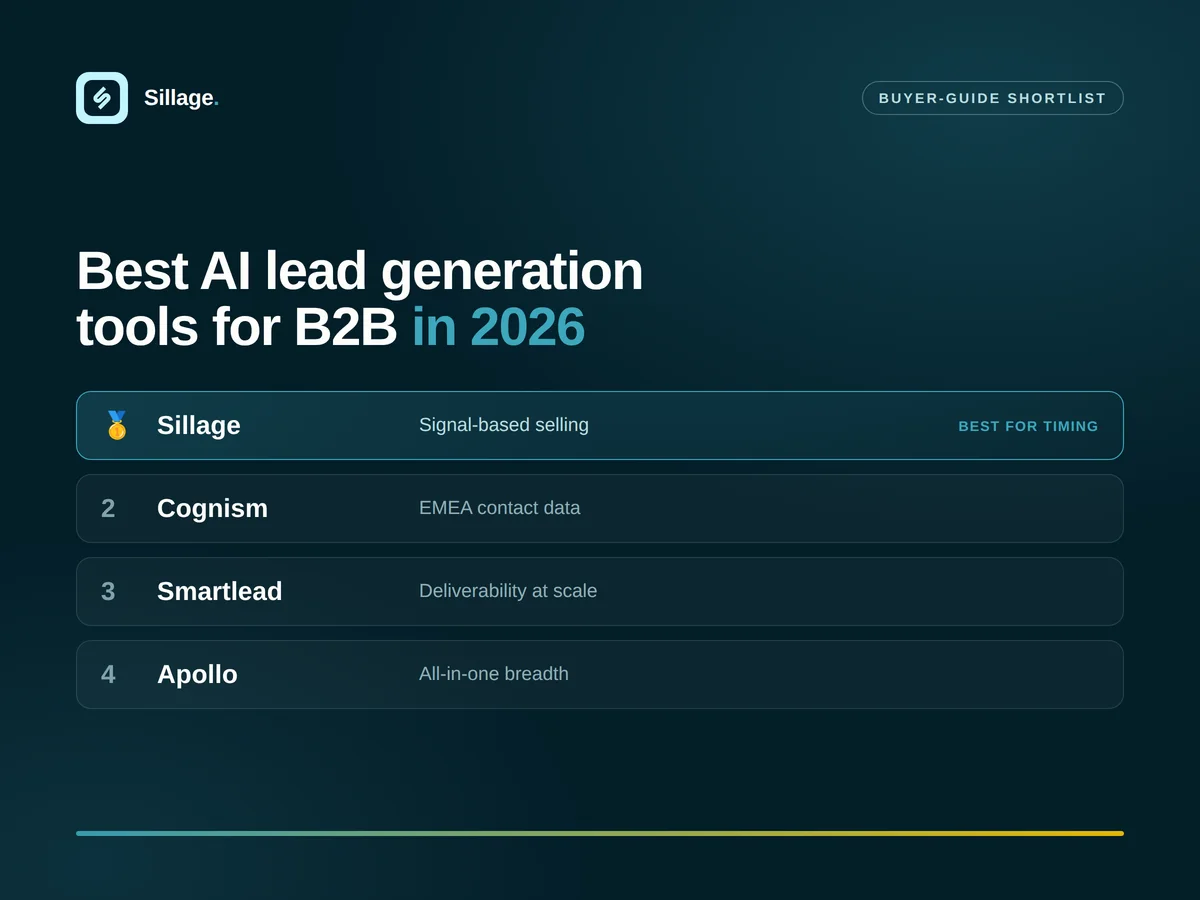
Picking the best AI lead generation tools for B2B in 2026 is no longer about who has the biggest database. Everyone has data. The teams generating pipeline are the ones who detect buying intent early, route it to a rep in seconds, and send at the right moment. This shortlist compares the platforms that actually move outbound metrics, grouped by the job they do, so you can assemble a stack instead of buying overlapping tools. For the play that ties them together, see Sillage's B2B signal-based selling platform.
How to read this shortlist
Lead generation in 2026 is a stack, not a single tool. Four jobs need covering, and most tools are strong at one or two, not all four:
- Data. Accurate contacts and firmographics.
- Signals. Knowing which contacts are worth acting on now.
- Delivery. Sending at scale without hurting deliverability.
- Routing. Getting the right lead to the right rep with context.
Buy for the gaps you actually have. The list below flags what each tool is genuinely best at.
The 2026 shortlist, by job
| Tool | Category | Best at | Weakest at |
|---|---|---|---|
| Sillage | Signal-based selling platform | Real-time named buying signals, Slack and CRM native | Not a raw contact database on its own |
| Cognism | Contact database | EMEA data accuracy, verified mobiles, compliance | Timing, named real-time signals |
| Apollo | All-in-one data and sequencing | Breadth, low entry price | Data depth in EMEA, signal freshness |
| Clay | Data orchestration | Enrichment waterfalls, flexibility | Steep setup, no native signal detection |
| Smartlead | Cold email infrastructure | Deliverability, inbox rotation at scale | No data, no signals |
| ZoomInfo | Enterprise data platform | US data breadth, enterprise integrations | Cost, refresh-cycle intent |
Quick verdict
If you want the short version before the detail:
- 🥇 Best for timing and signal-based outbound: Sillage. It is the layer that tells reps when to act, not just who to add.
- 🥈 Best for EMEA contact data: Cognism. Hard to beat for verified European mobiles.
- 🥉 Best for deliverability at volume: Smartlead. If sending is the bottleneck, start here.

AI-scored buying signal routed to the account owner
Thomas Roux from Back Market engaged with your competitor on LinkedIn
Why signal quality is the 2026 differentiator
Data volume commoditized. The teams winning pipeline detect intent before competitors and act within minutes, not on the next data refresh. A lead is only as good as the timing of the outreach around it. That is why the shortlist above puts signal-based selling at the top: it is the job that turns a database into pipeline. For the job-change-tracking niche specifically, see our comparison of UserGems alternatives.
The three signals that consistently outperform cold lists:
- Job changes inside target accounts, caught the day they happen.
- Competitor engagement by a named prospect, flagging an active evaluation.
- Hiring waves, the leading indicator that a team is about to spend in your category.
Three ICP scenarios
| Your situation | Recommended stack |
|---|---|
| Early-stage, EMEA-focused, small team | Cognism for data, Sillage for timing, one sending tool |
| Scaling outbound, high sending volume | Smartlead for delivery, Sillage to trigger on signal, Cognism or Apollo for data |
| Enterprise, complex accounts, AI on the roadmap | Sillage Signal API into your AI agents, ZoomInfo or Cognism for coverage |
For teams building AI agents on top of the signal feed, the Agentic GTM Hackathon in Paris (July 2026) shows concrete reference builds.
Frequently Asked Questions
What is the best AI lead generation tool for B2B in 2026?
There is no single best tool, there is a best stack. For most teams the highest-leverage addition is a signal-based selling platform like Sillage, because it turns existing data and sending tools into timely, relevant outreach. Pair it with a data provider and a delivery tool.
Do I need AI for lead generation?
AI matters most where it improves signal quality and routing speed, not where it just generates more generic emails. The best use of AI in 2026 is detecting and scoring named buying signals, then routing them to the right rep automatically.
How is a signal-based platform different from intent data?
Traditional intent data is often anonymous and account-level, refreshed on a cycle. A signal-based platform surfaces named, public, dated events per contact in real time, which makes them directly actionable for one-to-one outreach.
Can these tools work together?
Yes, and they should. Data, signals, delivery and routing are different jobs. The strongest stacks combine a data provider, a signal layer, and a sending tool rather than forcing one platform to do everything.
Which tool should I add first?
Add for your biggest bottleneck. If you have data and sending but poor timing, add the signal layer first. If your emails land in spam, fix delivery first. If reps hunt for contacts, fix data first.
Want to see the signal layer that sits on top of your current stack? Book a demo and watch Sillage turn your existing leads into timed, relevant plays.
Book a demo
Related plays
Other buyer-guide reads in this cluster:
- Cognism alternative for signal-based selling, the migration angle from a contact database.
- Smartlead alternative for signal-based outreach, the migration angle from a sending tool.
- Cognism vs Smartlead in 2026, the head-to-head for teams weighing both.
For the broader BOFU view, see the global sales intelligence tools comparison 2025.