


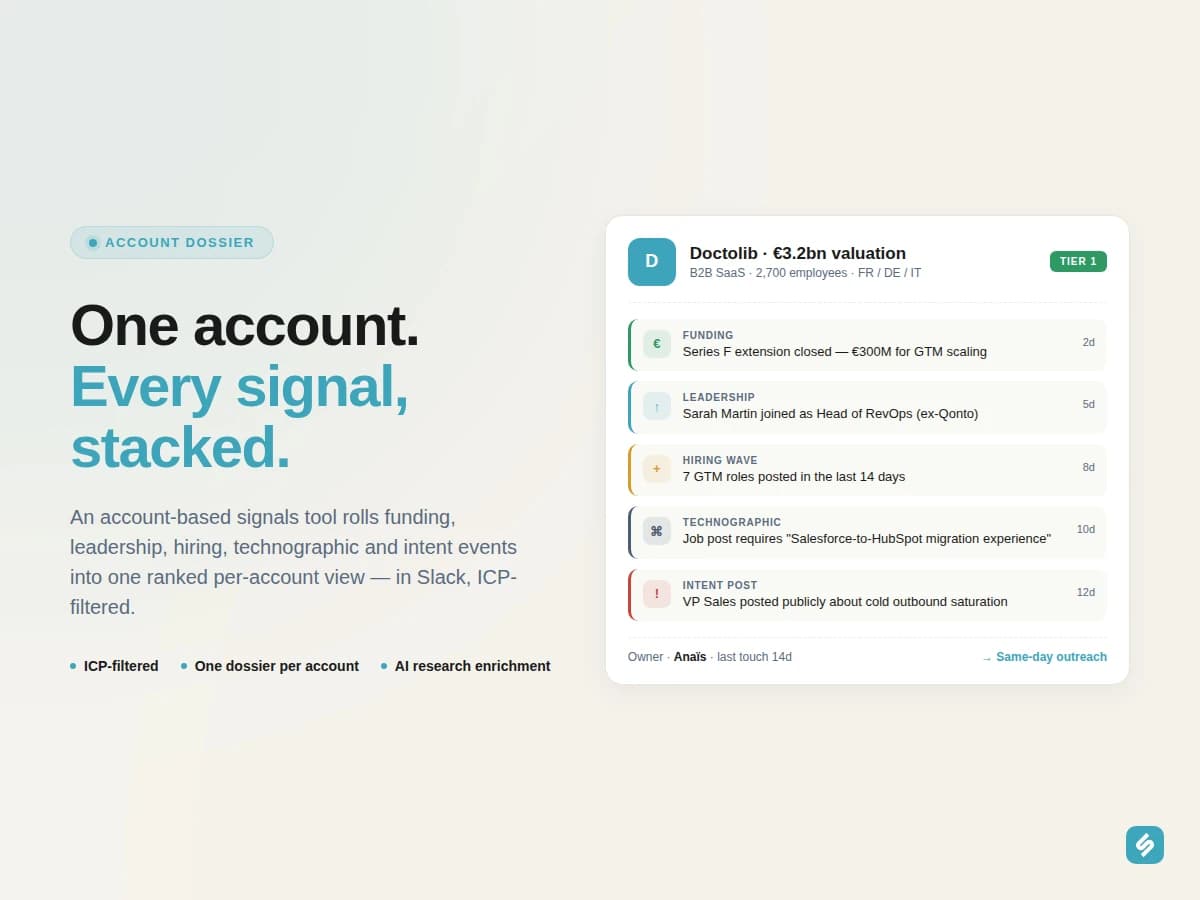
An account-based signals tool is what you reach for the moment you stop treating buying intent as a stream of isolated events and start treating it as a continuously updated dossier per target account. A funding round here, a VP RevOps hire there, a press release about market expansion, a job post requiring "experience migrating off [your competitor]", each one alone is interesting; aggregated per account and routed to the right rep, they become the most precise outbound prioritization model in B2B. This page sits inside our broader playbook on how signal intelligence is changing prospecting.
What is an account-based signals tool?
An account-based signals tool continuously aggregates public buying-intent events at the company level: funding rounds, M&A, leadership changes, expansion announcements, technographic mentions, hiring waves, regulatory or compliance updates, product launches. Each event alone is a thin signal. Stacked per account and refreshed in real time, they become a dossier your reps can use to decide who to call today, with what angle, and at what level of urgency. Knowing what pipeline signals trigger per event, and where each stakeholder sits on the account's power mapping for sales, is what turns the dossier into a sequence.
Three things separate a tool built for sales operators from generic company intelligence platforms:
- Account-level rollup, not event-level firehose. The system collapses N events on the same account into a single, ranked, contextualized view, not 47 separate emails.
- ICP qualification at the source. A funding round at a non-ICP company is not your problem. A funding round at a target account in your sweet spot is. The tool drops the first silently.
- AI-driven research enrichment. When a signal fires (e.g., new VP RevOps), the AI agent automatically pulls the underlying context, the strategic priorities mentioned in the announcement, the public statements of the new hire, the recent activity on the account, so the rep walks into the call already briefed.
"We replaced a $40k/year company-intelligence subscription with the account-based signals agent. Same data on the accounts we actually care about, half the noise, native in Slack. The CFO sent a thank-you note.", Sillage customer, RevOps Lead, B2B SaaS

Multi-signal stack on a target account
Sarah Martin from Doctolib engaged with your competitor on LinkedIn
Why per-account aggregation beats single-event alerts
The single-event alert model, "company X just raised", "person Y just posted", was the right answer for the previous generation of intent tooling. Three structural shifts in B2B sales have made it the wrong answer for 2026.
- Reps cannot triage 80+ alerts a day. Every signal vendor in your stack contributes its own feed. The rep stops reading after week two. Account-level rollup compresses 80 events into 10 ranked dossiers.
- Buying decisions are committee-driven. A single event tells you about one person. An account dossier tells you about the system, the new exec, the hiring wave they triggered, the technographic switch in the job posts, the public commentary from the CFO. That is what you actually need to write a relevant first message.
- AI agents need structured input. If you are starting to plug downstream AI orchestration into your outbound (auto-prospecting, auto-personalization, auto-routing), the input has to be a structured per-account state, not a raw event stream.
For the broader signal-stack framework, see B2B LinkedIn social listening tool. For the public-job-postings layer specifically, see B2B hiring signals software.
The four signal categories that compose an account view
A working account-based signals tool aggregates events from four categories. Each maps to a different motion on the rep's side.
Category 1, Funding and corporate events
Funding rounds, M&A announcements, IPO, restructuring, debt facilities. Each one is a budget-creation moment. A Series C announcement at a target account is a 60-90 day window where the company is allocating spend across the GTM stack.
Category 2, Leadership and team changes
C-level and VP-level hires, departures, promotions. The first 90 days of a new executive are when the tooling stack gets rebuilt. See real-time job change alerts software for the named-contact variant, and B2B champion tracking software for the trusted-contact play.
Category 3, Strategic and operational events
Expansion announcements, new market entries, product launches, partnership announcements, public statements about strategic priorities. These are the events that tell you what the company is going to spend money on next.
Category 4, Public sentiment and engagement
Public comments by executives on category topics, engagement patterns of decision-makers, keyword mentions in earning calls or press releases. See LinkedIn intent data tool for the keyword-detection layer.
| Signal category | Example event | Typical window | Best follow-up angle |
|---|---|---|---|
| Funding / corporate | Series C announcement | 60–90 days | Position as the natural stack layer for the scaling motion the round will fund. |
| Leadership change | New VP RevOps hire | 0–90 days | Catch them on day 1 with a peer-led intro from a similar-stage company. |
| Strategic event | EU expansion announcement | 30–120 days | Frame around the operational gaps the expansion will surface. |
| Public sentiment | CFO public post about cost reduction | 14–30 days | Reference the post directly; pitch the ROI angle in the first paragraph. |
How AI-driven account research actually works
Three layers separate a tool that produces useful per-account dossiers from one that just emails a noisy company-news feed.
Layer 1, Multi-source continuous monitoring
The agent watches multiple public sources in parallel: press releases, regulatory filings, LinkedIn, job boards, company blogs, news aggregators. Each event is normalized and tagged to a known account in your target universe.
Layer 2, Per-account aggregation and ranking
Events on the same account in the same window are collapsed into a single dossier and ranked by buying-intent strength. Three job posts + a funding round + a new VP RevOps in 30 days surfaces as one tier-1 alert, not three separate ones.
Layer 3, AI research enrichment
When a tier-1 dossier fires, an AI agent automatically pulls the underlying public context: the strategic priorities mentioned in the announcement, prior public statements of the new exec, comparable plays at similar-stage accounts in your customer base. The rep opens the alert in Slack and walks into the call already briefed. We host the broader AI-agent and GTM community at our Agentic GTM Hackathon in Paris, July 2026, where teams build live on top of this signal feed.
→ Same-day outreach
Combining account-based signals with the rest of the Sillage stack
The account view is most valuable when fed by the seven other signal agents. Sillage cross-references them automatically.
| Agent | What it adds to the account dossier |
|---|---|
| Job Updates Detection | Role transitions on the account, the named-contact layer of leadership changes |
| Champion Tracking | A former customer just joined, internal advocate flagged for the rep |
| Competitor's Activity | Rival reps are also engaging the account, race condition surfaced |
| Keyword Detection | Decision-makers publicly posted about the category, verbatim quote attached |
| Content Engagement | Account is engaging category content, leading indicator of awareness |
| Influencer Engagement | Decision-makers are following the category KOLs you track |
| Hiring Signals | Hiring patterns: waves, technographics, strategic first hires |
For the broader market comparison of signal platforms, see our roundup of the best AI tools for B2B prospecting. For the lead-scoring layer that ranks every signal in the dossier, see advanced lead scoring beyond demographics.
What Sillage does specifically for account-based signals
Three things separate a B2B-native account-based signals tool from a generic company intelligence dashboard:
- One dossier per account, not 47 alerts. Sillage rolls up every signal touching an account into a single, ranked, ICP-filtered view inside Slack and the CRM.
- No new tool, no new tab. The dossier lives where reps already work. Standalone "company intelligence" dashboards die at renewal because nobody opens them.
- AI agent extension. Sillage exposes the structured per-account signal feed via API. Custom AI orchestration tools (auto-prospecting, auto-personalization) consume the same source of truth that humans see.
Frequently asked questions
What is an account-based signals tool?
An account-based signals tool continuously aggregates public buying-intent events, funding rounds, leadership changes, expansion announcements, hiring patterns, technographic mentions, executive sentiment, per target account, then ranks and routes the dossier to the right rep in Slack and the CRM. It differs from event-level alert tools by collapsing the firehose into one ranked view per company.
How is it different from generic company intelligence platforms?
Generic platforms (think the classic "company news" subscription) push raw event feeds with no ICP gate and no per-rep routing. A B2B-native account-based signals tool starts from your defined target accounts, filters every event through your ICP, and surfaces only the patterns that map to buying intent, inside Slack and the CRM, with AI research enrichment attached.
Which sources does Sillage monitor?
Press releases and regulatory filings, LinkedIn (profiles, posts, engagement), public company career pages and ATS aggregators, news aggregators, public earnings call transcripts where applicable. The full source list is continuously expanding as new public-signal sources stabilize.
Does Sillage integrate with Salesforce and HubSpot?
Yes. Account dossiers and individual signals are enriched with CRM context (deal stage, last touchpoint, account owner) and routed as Slack alerts and CRM tasks natively. No Zapier or middleware.
How is ICP filtering applied at the account level?
Personas and account criteria defined inside Sillage (industry, company size, geography, stage, plus custom filters) act as a gate on every detected event. Non-ICP companies never produce an alert. Your reps see only target-universe accounts.
Can an AI agent consume the per-account signal feed?
Yes. Sillage exposes a structured Signal API that delivers the same per-account aggregation that humans see in Slack. Custom outbound AI orchestration, downstream scoring models, and CRM automations consume the same source of truth, so the rep's queue and the agent's queue stay in sync.
How long does setup take?
About five minutes for the first account-based signals agent: connect the CRM, define the target accounts and the ICP, choose the Slack channel for dossier alerts. No engineering involvement required.
Ready to consolidate every public signal touching your target accounts into one Slack-native dossier? Book a demo and see Sillage's account-based signals agent inside Slack and your CRM.
Book a demo
Related plays
Account-based signals are the consolidation layer over the other seven signal agents in the Sillage stack:
- Real-time job change alerts software, the named-contact leadership-change layer.
- B2B champion tracking software, re-engage former customers in the new accounts.
- B2B LinkedIn competitor monitoring tool, race-condition detection per account.
- LinkedIn intent data tool, verbatim public posts that feed the dossier.
- B2B LinkedIn social listening tool, category-level engagement layer.
- B2B KOL tracking & influencer marketing tool, KOL engagement signal.
- B2B hiring signals software, the hiring-pattern layer.
- B2B signal-based selling platform, the platform that orchestrates the eight signal agents.