


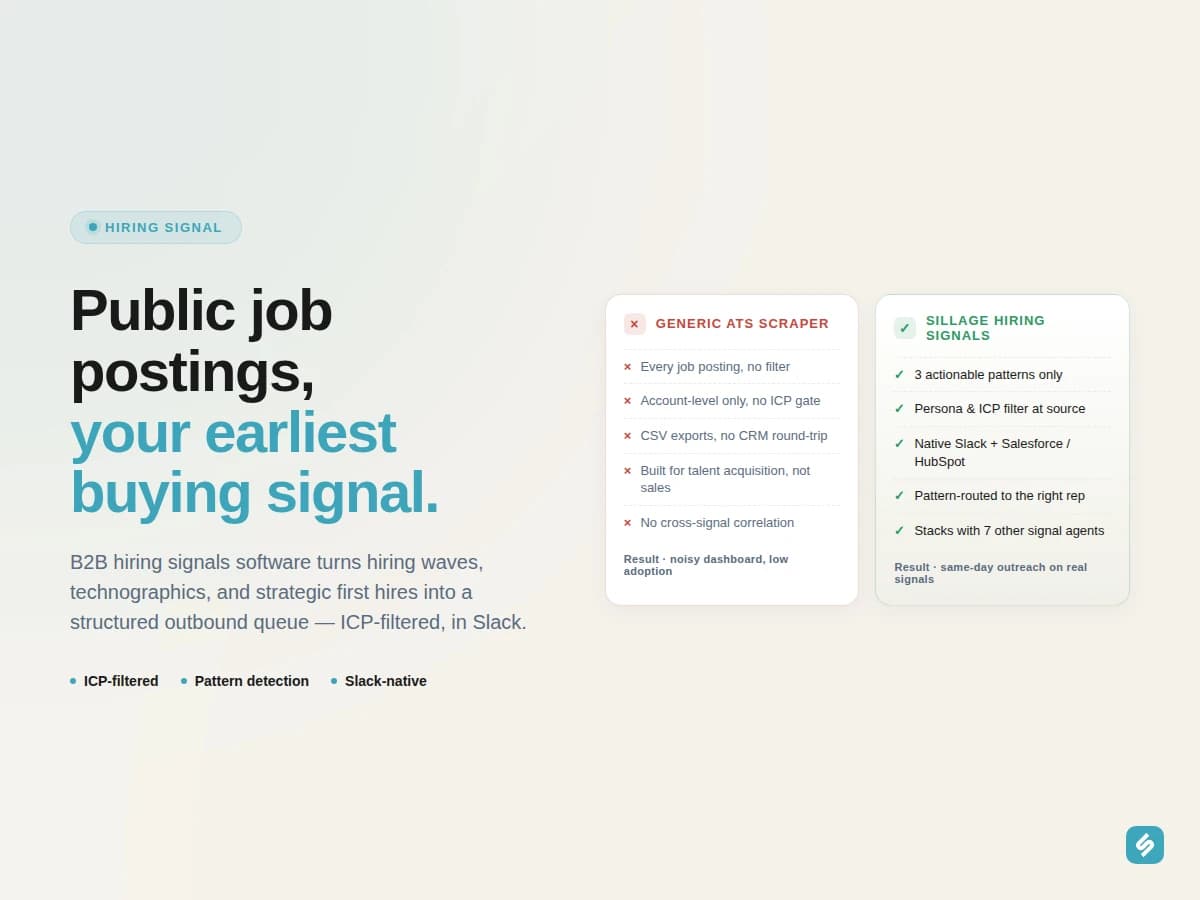
A B2B hiring signals software does what most sales teams have been trying to do manually for years: it watches public job postings across LinkedIn, company career pages, and aggregators in real time, and turns hiring patterns into a buying-intent layer your reps can actually act on. A company hiring five SDRs this quarter is allocating budget to outbound, that's a signal worth a same-day call. A target account suddenly posting for a "Salesforce Administrator" right after dropping their previous CRM is a 30-day buying window opening in public. This page sits inside our broader playbook on how signal intelligence is changing prospecting.
What is B2B hiring signals software?
Hiring signals software continuously monitors job postings, across LinkedIn, company career sites, ATS aggregators, and surfaces the patterns that map to buying intent in a specific B2B category. The valuable signal is rarely the individual job post. It is one of three layers:
- Hiring volume signal. A target company posting five GTM roles in 30 days is allocating fresh outbound budget, likely a tooling spend in the same window.
- Technographic signal. A job post that requires "experience with [your competitor]" tells you the stack is in place. A post asking for "experience migrating off [your competitor]" is a switching signal.
- Strategic role signal. A first-time hire for a VP RevOps, Head of Sales Enablement, or Director of Outbound is a budget-line-creation moment for everything that role buys in the first 90 days.
Generic ATS scrapers tell you "this company has 47 open jobs". A B2B hiring signals software built for sales tells you "this target account just posted three SDR roles and a RevOps role in the last 14 days, they're scaling outbound, here's the account context and the right rep to ping". The difference is what reps can act on without RevOps doing manual triage.
"We'd been ignoring job posts for years because we couldn't make sense of the noise. The hiring agent reframed it: we now treat a wave of GTM hiring on a target account the same way we'd treat a competitor's rep showing up. Same urgency, same playbook.", Sillage customer, RevOps Lead, B2B SaaS, 250 employees

Hiring wave detected on target account
Sarah Martin from Doctolib engaged with your competitor on LinkedIn
Why hiring patterns are a top-tier buying signal
Three structural reasons hiring beats most other intent signals on conversion rate, when filtered properly.
- Hiring is a leading indicator of spend. A company doesn't hire SDRs to keep its tech stack as-is. The buying decisions follow the hiring decisions by 30 to 90 days, and they are predictable by role.
- Hiring is public, named, and dated. Unlike intent data which is anonymized account-level, every job post is timestamped and tied to a known employer. No probabilistic guess.
- Hiring stacks naturally with your other signals. A hiring wave on an account where a past champion just landed is a triple-stacked signal, and it justifies same-day outreach.
Generic ATS scrapers miss all three because they were built for talent acquisition teams, not for sales operators. They surface every posting; they don't filter by ICP, they don't tie back to your CRM, and they don't route the signal to the rep who actually owns the account.
Three types of hiring signals that move pipeline
Not every job post deserves a sales touch. After thousands of routed alerts, three patterns reliably convert.
Pattern 1, The hiring wave
A target account posting four or more GTM roles (SDRs, AEs, RevOps, CS) in a 60-day window. This is the cleanest "budget allocated" signal in B2B. The buying decisions for tooling, enablement and data follow within 90 days.
Pattern 2, The technographic switch
A job post that asks for experience with a competing product, especially in the context of "migrating from X" or "consolidating from X to Y". The role itself is the public confession of a planned stack change.
Pattern 3, The strategic first hire
The very first VP RevOps, Head of Sales Enablement, or Director of Outbound at an account. The job description tells you the mandate. The first 90 days of that hire's tenure is when every adjacent tooling category is decided. Pair it with real-time job change alerts to catch the moment they land.
| Pattern | Trigger | Buying window | Best follow-up angle |
|---|---|---|---|
| Hiring wave | 4+ GTM roles posted at one account in < 60 days | 30–90 days | Frame as the natural tooling layer for the scaling motion. |
| Technographic switch | Post requires migration off / experience with a competitor | 30 days | Send a 1-pager comparison + a case study of the same migration. |
| Strategic first hire | First VP RevOps / Head of Enablement / Director of Outbound | 0–90 days | Catch them on day 1 of the new role with a peer-led intro from a similar company. |
How B2B hiring signals software actually works
Three layers separate a tool that consistently moves pipeline from one that just scrapes job boards.
Layer 1, Continuous job posting monitoring
The system watches LinkedIn job postings, company career pages and ATS aggregators in real time across your defined target universe. Polling needs to be daily or better, a 7-day-old job post in B2B SaaS already has 50+ applicants and the budget conversation is happening.
Layer 2, ICP qualification at the source
A raw "company X is hiring" notification is operational debt. The signal must be cross-checked against your Ideal Customer Profile (industry, company size, geography, plus role and pattern criteria) before any human is paged. Non-matching events drop silently.
Layer 3, Pattern recognition + CRM routing
The agent doesn't fire on a single posting, it fires on patterns: hiring waves, technographic mentions, strategic first hires. Each alert lands in Slack and as a CRM task on the right account owner, with the full posting context, the inferred buying angle, and a suggested outreach. The rep crafts a 3-minute reply that references the specific roles being hired.
Combining hiring signals with the rest of the Sillage stack
A hiring signal is most valuable when stacked with other buying signals on the same account. Sillage cross-references the Job Posting Insights agent with seven other agents.
| Agent | What it adds to a hiring signal |
|---|---|
| Job Updates Detection | A new decision-maker just landed alongside the hiring wave, confirmed budget owner |
| Champion Tracking | A former customer joined the account doing the hiring, internal advocate already in place |
| Competitor's Activity | A rival rep is engaging the same account, race condition active |
| Keyword Detection | Decision-maker publicly posted about the same pain the new role will solve |
| Content Engagement | The account is engaging category content alongside the hiring wave |
| Influencer Engagement | New hires are following the category KOLs you also track |
For the broader signal-stack framework, see B2B LinkedIn social listening tool. For the named-buyer keyword angle, see LinkedIn intent data tool.
What Sillage does specifically for hiring signals
Three things separate a B2B-native hiring signal tool from a generic ATS scraper:
- Pattern detection, not posting feeds. Sillage groups postings into the three actionable patterns (hiring wave, technographic switch, strategic first hire) and only alerts on the patterns, not on every new job.
- No new tool, no new tab. Alerts land in Slack and your CRM. There is no separate hiring-signals dashboard for AEs to remember to open, adoption stays above 90 % at six months.
- Cross-signal correlation. A standalone hiring wave is interesting. A hiring wave on an account where a competitor's rep is also active and a past champion just joined = a tier-1 deal forming in front of you. Sillage stacks signals automatically.
If you are evaluating the broader market before committing, our roundup of the best AI tools for B2B prospecting covers the main alternatives. And to see how AI-agent teams are building outbound automation directly on top of hiring signals, join our Agentic GTM Hackathon in Paris (July 2026).
Frequently asked questions
What is B2B hiring signals software?
B2B hiring signals software continuously monitors public job postings across LinkedIn, company career pages and ATS aggregators, qualifies the hiring patterns against an Ideal Customer Profile, and routes the matched signals to sales reps in real time. It treats hiring waves, technographic mentions and strategic first hires as buying intent, not as recruitment data.
How is it different from a generic ATS scraper?
A generic ATS scraper surfaces every job posting at every company. A B2B-native hiring signals tool surfaces only the patterns that map to buying intent in your category, filtered by your ICP, and routes them to the right rep in Slack and the CRM. It is built for sales operators, not talent acquisition teams.
What roles should we monitor?
The roles most predictive of buying intent in B2B SaaS are GTM-adjacent: SDRs, AEs, RevOps, Sales Enablement, Marketing Ops, and the senior leadership variants of those (VP RevOps, Head of Sales Enablement, Director of Outbound). For technographic switches, narrow to roles that require experience with the competitor you displace.
Does Sillage integrate with Salesforce and HubSpot?
Yes. Hiring signals are enriched with CRM context (deal stage, last touchpoint, account owner, prior signal history) and routed as Slack alerts and CRM tasks natively. No Zapier or middleware required.
How is ICP filtering applied to hiring signals?
Personas defined inside Sillage (role, seniority, company size, industry, geography) act as a gate on every detected hiring event. Non-fits are dropped silently. Your reps only see hiring waves, technographic switches and strategic first hires at accounts that match your target market.
Can hiring signals be combined with other buying signals?
Yes, and that's where the leverage compounds. A hiring wave combined with a competitor's rep engaging the same account, a recent champion landing there, or a public keyword post creates a triple-stacked signal that justifies a same-day outreach. Sillage handles the stacking automatically across all eight signal agents.
How long does setup take?
About five minutes for the first Job Posting Insights agent: connect the CRM, define the Personas, select the role categories and patterns to monitor, choose the Slack channel for alerts. No engineering involvement required.
Ready to turn public job postings into a structured outbound queue? Book a demo and see Sillage's Job Posting Insights agent inside Slack and your CRM.
Book a demo
Related plays
Hiring signals are one of eight signal agents in the Sillage stack. Most teams stack them with:
- Real-time job change alerts software, catch the new hires arriving at the accounts you flagged.
- B2B champion tracking software, re-engage former customers landing in those hiring accounts.
- B2B LinkedIn competitor monitoring tool, race condition detection on the same accounts.
- LinkedIn intent data tool, named buyers publicly posting about the same pain the new roles will solve.
- B2B LinkedIn social listening tool, broader category engagement around the hiring accounts.
- Account-based signals tool, roll the hiring wave into the full per-account dossier.
- B2B signal-based selling platform, the full eight-agent platform context.