


A B2B KOL tracking tool is what happens when sales teams realise that the most valuable real estate in 2026 is not the inbox, it is the LinkedIn feed of a trusted creator inside your category. Around the top voices in any B2B space, your buyers gather, engage, and signal exactly when they are evaluating solutions. The job of a KOL tracking platform is to find those buyers inside the audience, qualify them against your ICP, and ship the signal to your reps before the cold-email crowd shows up. This page sits inside our broader playbook on how signal intelligence is changing prospecting.
What is B2B KOL tracking?
A KOL, Key Opinion Leader, is someone whose voice your buyers trust more than your sales team. In B2B, KOLs are not Instagram influencers. They are practitioners: a fractional CRO, a head of RevOps with 30k followers, a fintech founder writing weekly about payment infrastructure. When a KOL publishes, the people who like, comment, and re-share are statistically over-indexed on category awareness and budget.
B2B KOL tracking is the discipline of monitoring those audiences continuously, identifying ICP matches in real time, and routing the resulting signals to outbound teams. It sits at the intersection of influencer marketing (the brand side) and signal-based selling (the sales side).
"We had no idea our top three deals last quarter all started with a comment on the same VP RevOps's posts. Once we instrumented that, we cut our sourcing time in half.", anonymous Sillage customer, B2B SaaS, 200 employees

KOL engagement on a target account
Sarah Martin from Doctolib engaged with your competitor on LinkedIn
Why B2B influencer marketing is the new outbound channel
Outbound is broken at scale. Cold email reply rates have collapsed below 1 %, cold calling connect rates hover near 5 %, and prospects know within two seconds whether a message was AI-generated. Meanwhile, the same prospects spend 30 to 60 minutes a day reading B2B creators on LinkedIn.
Two shifts have made KOL audiences the most valuable sourcing layer of the year:
- Creator trust replaces vendor trust. Buyers ignore vendor content and consume practitioner content. The signal-to-noise ratio is inverted.
- Engagement is public. Unlike webinar attendance or gated content downloads, LinkedIn engagement happens in the open. A like or a comment is a public buying-intent gesture.
The teams winning right now are not buying ads. They are mapping the ten to fifty KOLs that matter in their category, tracking engagement continuously, and running outbound on the qualified subset, at a fraction of the cost of paid acquisition. For a related approach, see our B2B LinkedIn social listening tool page.
Three patterns of KOL engagement that signal buying intent
Not every like deserves a sales touch. After thousands of routed alerts, three patterns consistently turn into pipeline.
Pattern 1, Repeated engagement on the same KOL
A prospect who likes four posts from the same KOL in two weeks is not casually scrolling. They are following a thinker because the topic matches an active priority. Combined with the ICP filter, this is the cleanest top-of-funnel KOL signal.
Pattern 2, Comments on actionable posts
Comments take effort. When a prospect leaves a substantive comment on a "how we built our outbound stack" post by a KOL, they are publicly signalling that the topic is on their agenda right now. The post's content gives you the exact angle for outreach, no guessing required.
Pattern 3, Multi-KOL convergence
The strongest pattern: the same prospect engages with two or three different KOLs in the same category within a short window. That is a buyer doing structured research. Combined with a recent job change or a competitor engagement, you have a triple-stacked signal, the kind that justifies a same-day call.
| Pattern | Trigger | Conviction | Best follow-up angle |
|---|---|---|---|
| Repeated single-KOL engagement | 4+ engagements on same KOL in 2 weeks | Mid | Soft DM referencing the KOL's recent theme. |
| Substantive comment | Comment with on-topic context, not just emoji | High | Reply with a one-paragraph alternative angle on their comment. |
| Multi-KOL convergence | Engagement with 2+ category KOLs in < 14 days | Top-tier | Same-day DM + book a 20-minute call this week. |
How to identify the right KOLs for your category
The mistake here is to chase follower counts. A KOL with 200k followers and a generic audience produces lower-quality signals than a KOL with 15k followers and a tight practitioner base. The right shortlist is built on three criteria:
- Audience overlap with your ICP. Run a quick audit: of the last 50 reactors on the KOL's recent posts, how many match your Personas? Below 20 %, the KOL is too broad.
- Engagement depth. Comments-to-likes ratio above 5 % indicates an active community, not a passive audience.
- Topic alignment. The KOL's recurring themes must map directly to the problem you sell into. A KOL who occasionally mentions your space is not a KOL, they are a noise source.
A working B2B KOL tracking setup typically follows ten to thirty KOLs across two to four sub-topics inside the category. Beyond that, signal quality dilutes and the team gets overwhelmed.
The workflow, from KOL audience to qualified meeting
The point of a B2B KOL tracking tool is to compress the path from "someone engaged" to "rep takes action" into minutes, not days. The working motion is five steps.
- Define the KOL list. Ten to thirty practitioners whose audience overlaps your ICP.
- Monitor engagement continuously. Every like, comment, share, and significant view on the KOLs' posts is captured.
- Filter by ICP. Only engagement from contacts matching the Personas (role, seniority, company size, industry, geo) survives.
- Enrich with CRM context. Existing deal stage, last touchpoint, account owner, and any prior signal history are attached to the alert.
- Route to Slack and CRM. The rep sees the alert in their working environment, with the engaged post linked and a suggested outreach angle.
A rep can craft a relevant message in under three minutes, not "I saw you liked X's post" but "saw your comment on [KOL]'s piece about [topic]. We help [Company size] sales teams solve exactly that. Open to comparing notes?". That cycle, from public engagement to outbound, runs end-to-end in well under two hours.
Combining KOL signals with the rest of the Sillage stack
A KOL engagement is most valuable when it stacks with other buying signals on the same account. Sillage cross-references the Influencer Engagement agent with seven other agents.
| Agent | What it adds to a KOL engagement alert |
|---|---|
| Content Engagement | Same prospect engaging with broader category conversations |
| Job Updates Detection | Recent role change = fresh budget window |
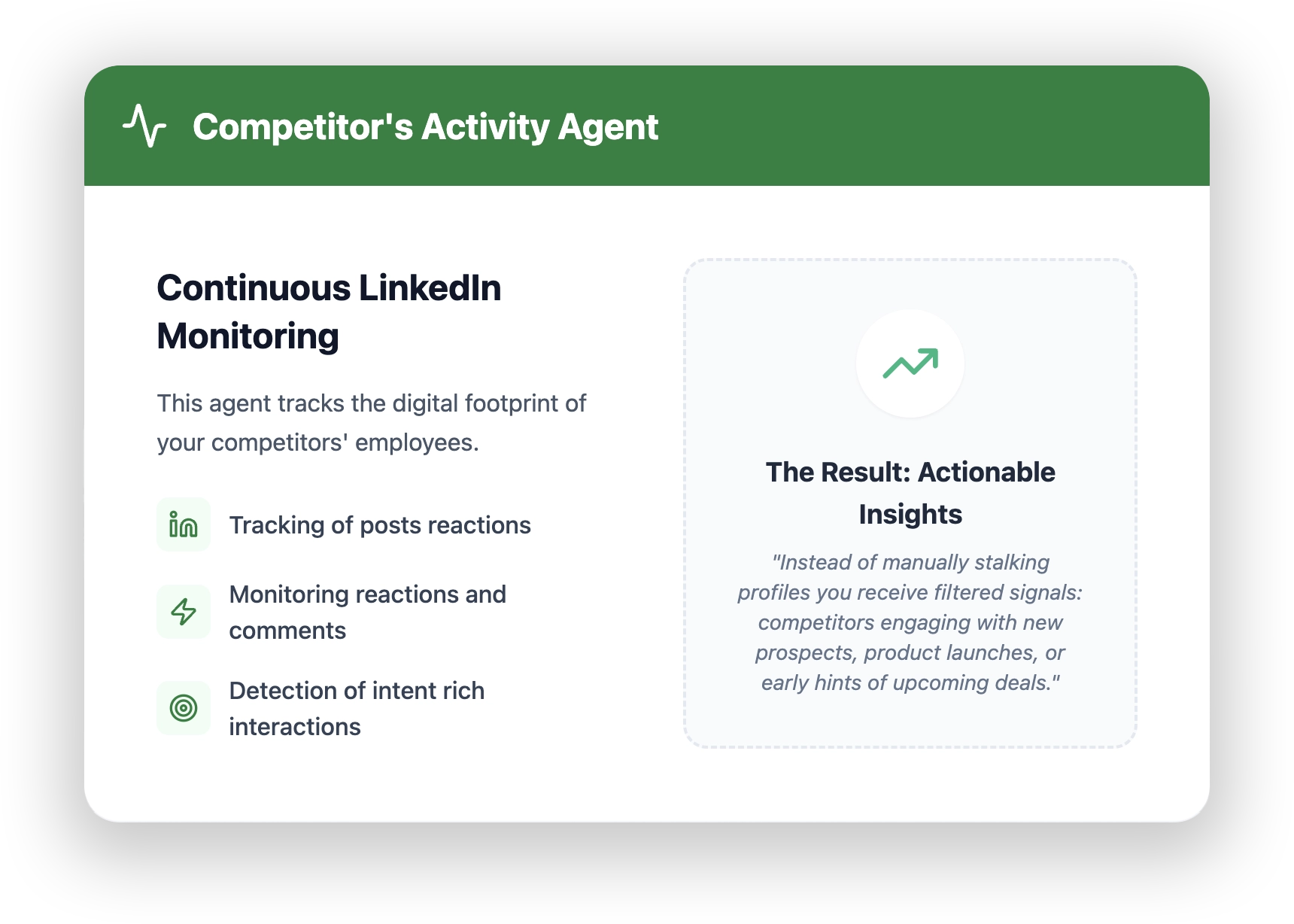
| Competitor's Activity | A rival rep is also working the account |
| Keyword Detection | Prospect publicly posted about the pain you solve |
| Champion Tracking | A former customer just joined the engaging account |
| Hiring Signals | The account is hiring roles tied to your category |
For the keyword detection layer, see how to detect prospects who publicly post about their pain points on LinkedIn.
What Sillage does specifically for KOL tracking
Three things separate a B2B-native KOL tracker from a generic influencer dashboard:
- ICP filtering at the source. A KOL's audience is large by design. Without an automatic ICP gate, your reps would receive hundreds of irrelevant alerts a day. Sillage filters every engagement event against your Personas before it ever reaches a human.
- No new tool, no new tab. Alerts land in Slack and your CRM. There is no separate dashboard for AEs to remember to open, which means adoption stays above 90 % at six months, where standalone influencer tools usually collapse.
- Cross-signal correlation. A standalone KOL like is interesting. A KOL like from a contact who just changed jobs at a target account is a meeting. Sillage stacks these signals automatically.
The result is a creator-led outbound motion that does not require hiring a creator marketing manager, running paid campaigns, or sponsoring a single post. You simply listen to where your buyers already gather.
Frequently asked questions
What is a B2B KOL tracking tool?
A B2B KOL tracking tool monitors engagement (likes, comments, shares, follows) on the LinkedIn content of selected Key Opinion Leaders in a B2B category, qualifies every engaging contact against an Ideal Customer Profile, and routes matched signals to sales reps in real time. It turns creator audiences into a structured outbound source.
How is KOL tracking different from influencer marketing?
Traditional influencer marketing pays creators to broadcast a brand message. KOL tracking is the reverse: you do not pay the creator. You observe their audience and identify buyers who self-qualify by engaging. It is a sourcing motion, not a media buy.
How many KOLs should we track?
Ten to thirty KOLs across two to four sub-topics in your category is the working range. Beyond that, signal quality dilutes and reps get alert fatigue. The right shortlist is built on audience-ICP overlap and engagement depth, not raw follower counts.
Does Sillage integrate with Salesforce and HubSpot?
Yes. KOL engagement signals are enriched with CRM context (deal stage, last touchpoint, account owner) and routed as Slack alerts and CRM tasks natively. No Zapier or middleware required.
How is ICP filtering applied to KOL audiences?
Personas defined inside Sillage (role, seniority, company size, industry, geography) act as a gate on every engagement event detected on the tracked KOLs' content. Only matching contacts produce an alert. The unmatched 80–95 % is dropped silently.
Can we cross-reference KOL engagement with other buying signals?
Yes, and that is where the leverage compounds. KOL engagement combined with a recent job change, a competitor's rep engaging the same account, or a public keyword post creates a triple-stacked signal that justifies a same-day outreach. Sillage handles the stacking automatically across all eight signal agents.
How long does setup take?
About five minutes for the first Influencer Engagement agent: connect the CRM, define the Personas, paste the KOL LinkedIn URLs, choose the Slack channel for alerts. No engineering involvement required.
Ready to turn the creators in your category into a structured outbound pipeline? Book a demo and see Sillage's KOL tracking inside Slack and your CRM.
Book a demo
Related plays
KOL tracking is one of eight signal agents in the Sillage stack. Most teams stack it with:
- B2B LinkedIn competitor monitoring tool, pair influencer engagement with rival rep activity on the same accounts.
- Real-time job change alerts software, fresh role + KOL engagement = top-tier signal.
- B2B champion tracking software, re-engage warm contacts who appear in creator audiences after a job change.
- LinkedIn intent data tool, catch named buyers publicly posting about your category.
- scoring beyond firmographics, weight KOL engagement properly in your model.
- B2B hiring signals software, turn job postings into the leading indicator of category spend.
- Account-based signals tool, consolidation layer over all signal categories, per account.
- B2B signal-based selling platform, the full eight-agent platform context.
- How signal intelligence is changing prospecting, the broader framework.