

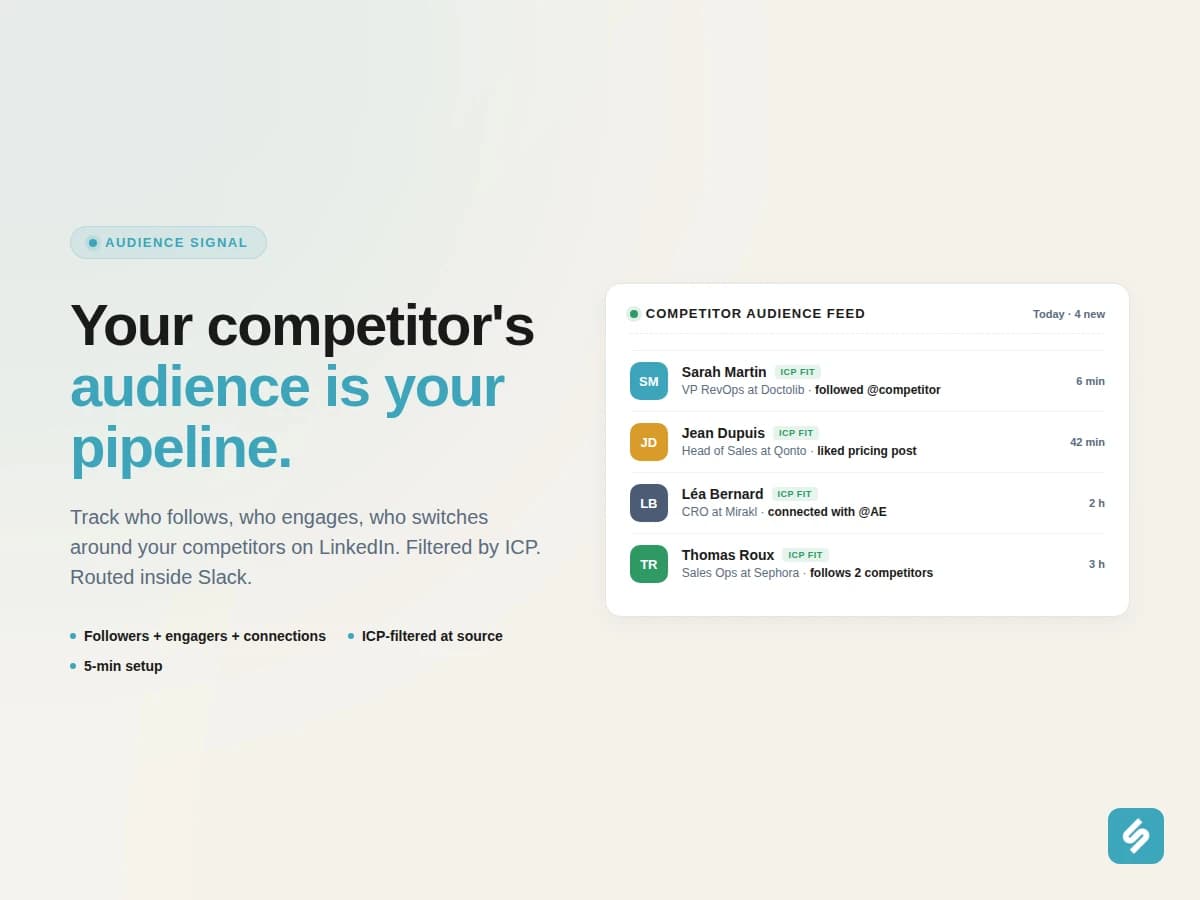
Knowing how to track competitor audience and followers on LinkedIn is one of the quietest and most underused buying-signal plays in B2B. Every new follower, every engagement, every job change inside a competitor's orbit is a public, dated, named event. Aggregated against your ICP and routed to the right rep, it turns "they grew their audience by 4 % this month" into a list of named buyers actively evaluating your category. This page sits inside our broader playbook on the B2B LinkedIn competitor monitoring tool.
What does tracking a competitor's audience actually mean
At first glance, "audience" sounds like a marketing metric. For sales operators, audience tracking is a tactical buying-signal layer. There are three populations worth watching around each competitor:
- Followers of the competitor's company page (passive but persistent interest)
- Engagers who like or comment on the competitor's posts (active interest)
- Connections of the competitor's GTM employees on LinkedIn (relationship-level interest)
Each one is a public signal. Crossed with your ICP, each one produces a list of buyers worth a call this week.
"We watched 6 competitor company pages for 90 days. The reps got 312 ICP-matched alerts, booked 41 demos, closed 4 deals. The tool paid for itself in the first month." — Sillage customer, Head of Sales, B2B SaaS

ICP-matched buyer just followed a competitor
Sarah Martin from Doctolib engaged with your competitor on LinkedIn
Why audience tracking beats most other "competitor intel"
Most competitor intelligence tools focus on the wrong layer. They surface social media mentions, press articles, share-of-voice graphs. Useful for a marketing report, useless for an SDR.
Audience and follower tracking sits one layer down, on the named-contact buying-signal layer, and that is what moves pipeline. Three structural reasons it works:
- Public and dated. Every follow or engagement is timestamped on a public profile. No probabilistic guess, no data co-op.
- Granularity at the right level. Not "Acme Corp is interested", but "Sarah Martin, VP RevOps at Doctolib, just followed your competitor and liked their latest pricing post".
- Naturally ICP-filterable. The signal source is a named LinkedIn profile, so role, seniority, company size, and geography are right there to filter on.
Three follower behaviors that signal buying intent
Not every new follower is a buyer. Three patterns, drawn from thousands of alerts routed through the Sillage Competitor's Activity agent, reliably convert.
Pattern 1 — The fresh follow + same-week engagement
A new follower of a competitor's company page who also likes or comments on a post within seven days is doing structured vendor research. This is the cleanest top-of-funnel intent signal in B2B.
Pattern 2 — The cross-competitor follower
A prospect who follows two or three competitors in the same category within a short window is past the early curiosity stage. They are building a shortlist.
Pattern 3 — The decision-maker follower spike
When a single named decision-maker (VP RevOps, Head of Sales, CRO) starts following a competitor right after a job change, you have a 30 to 90-day buying window opening. See real-time job change alerts software for the stack play.
| Behavior pattern | Trigger | Conviction | Best follow-up angle |
|---|---|---|---|
| Fresh follow + early engagement | Follow + like within 7 days | High | Reply within 48h with a positioning one-pager. |
| Cross-competitor follower | Follows 2+ competitors in 14 days | Top-tier | Send a 3-vendor comparison; book a 20-minute call. |
| Decision-maker follower spike | New role + new competitor follow | Top-tier | Exec-to-exec intro from a peer who switched. |
How to actually track audience and followers at scale
A robust tracking setup runs three loops in parallel and merges the output into a single per-account view.
Loop 1 — Company page follower tracking
Daily polling of each competitor's company page. Every new follower is captured, the LinkedIn profile is parsed, the company and role are extracted.
Loop 2 — Post engagement tracking
The competitor's last 30 days of posts are watched. Every like, comment, share is captured with the engager's profile.
Loop 3 — GTM employee monitoring
The competitor's sales reps (SDR, AE, CRO) are monitored individually. Their LinkedIn activity, their new connections, their post engagements all feed the dossier.
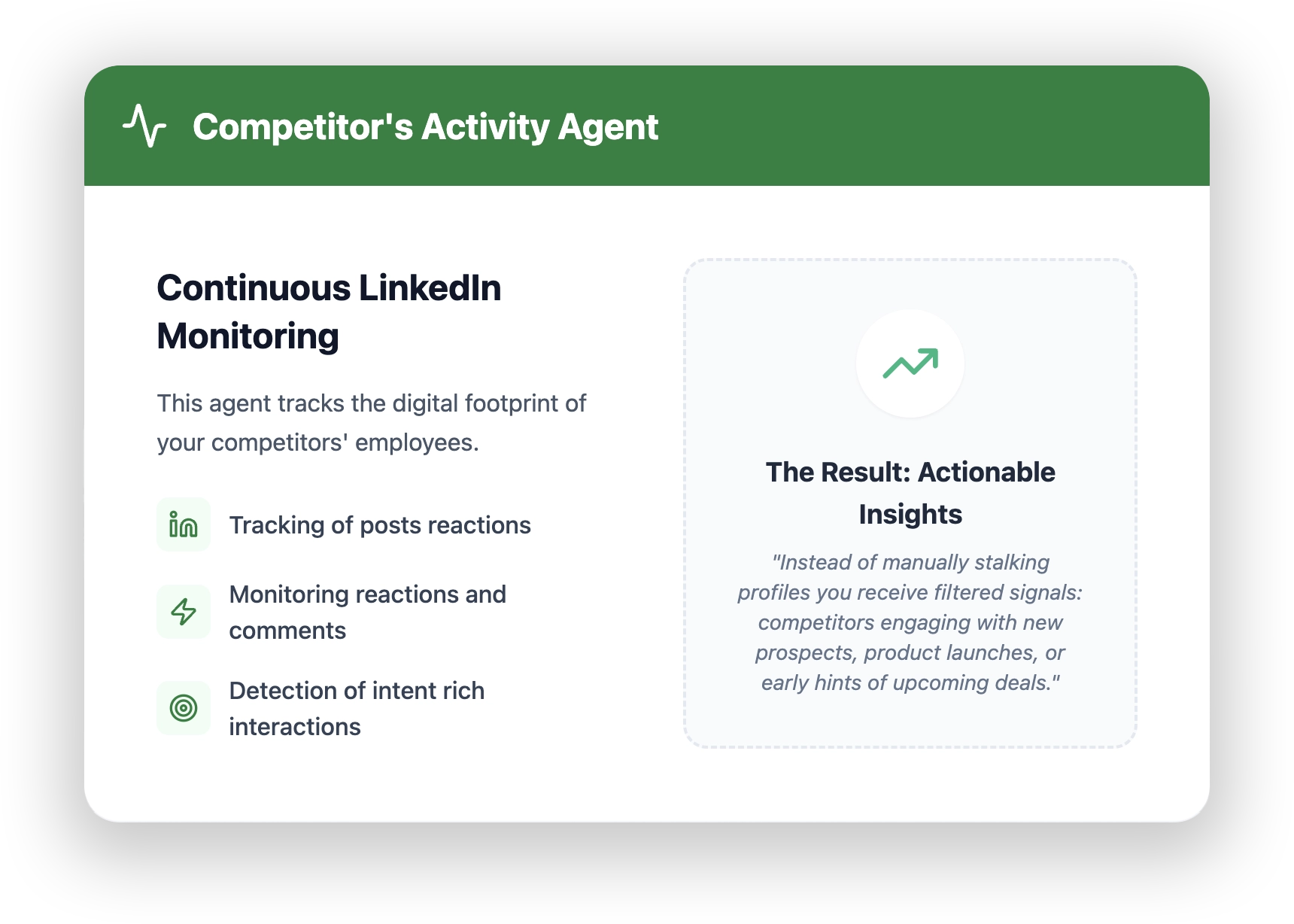
The three loops merge into one ICP-filtered alert queue. Reps see five to fifteen high-conviction alerts per day per competitor, each with a clear next action.
From a follower signal to a qualified meeting
The workflow from a public follow to a booked meeting runs in four steps and stays entirely inside Slack and the CRM.
- Detect. The Competitor's Activity agent watches the 3 to 5 competitors you defined, 24/7.
- Filter. Each detected follow, engagement, or connection is checked against your Personas. Non-fits drop silently.
- Enrich. The alert is composed with the prospect's role, account, last touchpoint from the CRM, and the suggested outreach angle.
- Route. The Slack channel notifies the right rep, and a CRM task is created on the account owner.
The rep crafts a relevant message in under three minutes. Not "I see you follow [competitor]" but "saw you started following [competitor] last week. We have a comparison one-pager I'd be happy to send. Open?".
Combining audience signals with the rest of the Sillage stack
The audience layer is most powerful when stacked with other agents on the same account.
| Agent | What it adds to an audience signal |
|---|---|
| Job Updates Detection | Same prospect just changed role, fresh budget window confirmed |
| Champion Tracking | The new follower is a former customer at a new ICP account |
| Content Engagement | Same prospect engages with category content beyond competitors |
| Keyword Detection | Same prospect publicly posted about your category |
| Hiring Signals | The account is recruiting roles tied to your category |
For the deeper tactical play of intercepting deals via competitor activity, see how to turn competitor LinkedIn activity into pipeline.
Frequently asked questions
Can I track competitor followers manually?
Yes, on a small scale. For 1 competitor and 100 followers, manual tracking is feasible. For 3 to 5 competitors with thousands of followers each, plus daily engagement on every post, manual tracking collapses by the second week. Automation becomes necessary.
Is tracking a competitor's LinkedIn audience against the platform's terms?
Tracking publicly visible engagement and followers respects LinkedIn's rules. The Sillage Competitor's Activity agent operates strictly on public data, no scraping of private profiles, no automated requests against authentication walls. The signals come from what LinkedIn already shows the world.
How many competitors should I track?
Three to five. Tracking more dilutes the alert quality and overwhelms reps. The right shortlist is built from your win/loss data, your ICP overlap, and the vendors that show up most often in your deals.
Does the ICP filter remove relevant signals?
Only the non-fitting ones. The Persona definition (role, seniority, company size, industry, geography) drops 90 to 95 % of raw LinkedIn volume, which is the right number. The 5 to 10 % that remain are your buyers. Reps see five to fifteen high-conviction alerts per day per competitor, not 4 000-row dashboards.
How does this differ from broad social listening?
A B2B LinkedIn social listening tool watches category-level conversations, broader than just competitors. Audience tracking is the narrower, competitor-specific layer. Most enterprise sales teams run both, with the same ICP definition.
How long does setup take?
About five minutes for the first Competitor's Activity agent. You connect the CRM, paste the competitor company URLs, choose the Slack channel, and the agent starts running.
Can the audience signal feed an AI agent or workflow?
Yes. The Signal API exposes the structured per-account audience feed for downstream AI orchestration, the same source of truth that humans see in Slack.
Ready to turn your competitors' LinkedIn growth into your pipeline? Book a demo and see Sillage's Competitor's Activity agent at work.
Book a demo
Related plays
The 4 plays inside the competitor monitoring cluster:
- Turn competitor LinkedIn activity into pipeline, the tactical play on intercepting deals.
- Best B2B LinkedIn competitor monitoring tool, the 2026 shortlist, the buyer's-guide comparison.
- Pharow alternative for B2B competitor monitoring, for teams looking to switch.
- Pharow vs Sillage: automate competitor analysis, the head-to-head.