


Learning to track competitor LinkedIn activity is the single most underused buying signal in B2B sales. Right now your competitors' AEs and SDRs are liking posts, dropping comments, and warming up your target accounts in plain sight, and most sales teams find out during the loss review. This guide shows how to detect that activity in real time, qualify it against your ICP, and turn it into pipeline before the RFP is even drafted. See also our complete B2B LinkedIn competitor monitoring tool page.
Your competitors' sales reps are prospecting right now. They're:
- liking posts
- dropping comments
- sending connection requests
- all on LinkedIn, all in plain sight.
Each interaction tells you something: who they're targeting, which accounts they're warming up, and where they see opportunity. The problem is most sales teams have zero visibility into this. They find out a competitor was in the deal during the loss review call. By then, it's too late.
What if you could see every interaction between your competitors and your target accounts on LinkedIn and turn that intelligence into pipeline? That's exactly what Sillage Competitors’ monitoring agent does. And it’s probably the most powerful, and underused buying signal in B2B. Stop missing RFPs
How can I identify buying signals at the same time of my competitor?
Here's the harsh reality: most RFPs are already decided before they're even sent out. The vendor who gets selected? They didn't just respond to the RFP - they helped write it. They built trust. Or at least, they influenced it.
Arriving late on a deal means chances of winning are thin. According to Gartner, B2B buyers spend roughly 70% of their decision-making journey before they even start the buying process.
This is where competitor monitoring becomes your early warning system. When you see a competitor's sales team consistently engaging with a specific account - multiple touchpoints, strategic comments, building relationships with key stakeholders: that's not casual networking.
That's the pre-RFP phase. They're positioning themselves as a trusted advisor before the formal procurement process begins.
If you can detect this activity early, you have time to:
- Reach out to parallel stakeholders in the same organization
- Build your own relationships before the request for proposal is drafted
- Position your solution as an alternative worth evaluating
- Get yourself included in the vendor consideration set
How to track and create intelligence pipeline from the data of your competitors' LinkedIn activity?
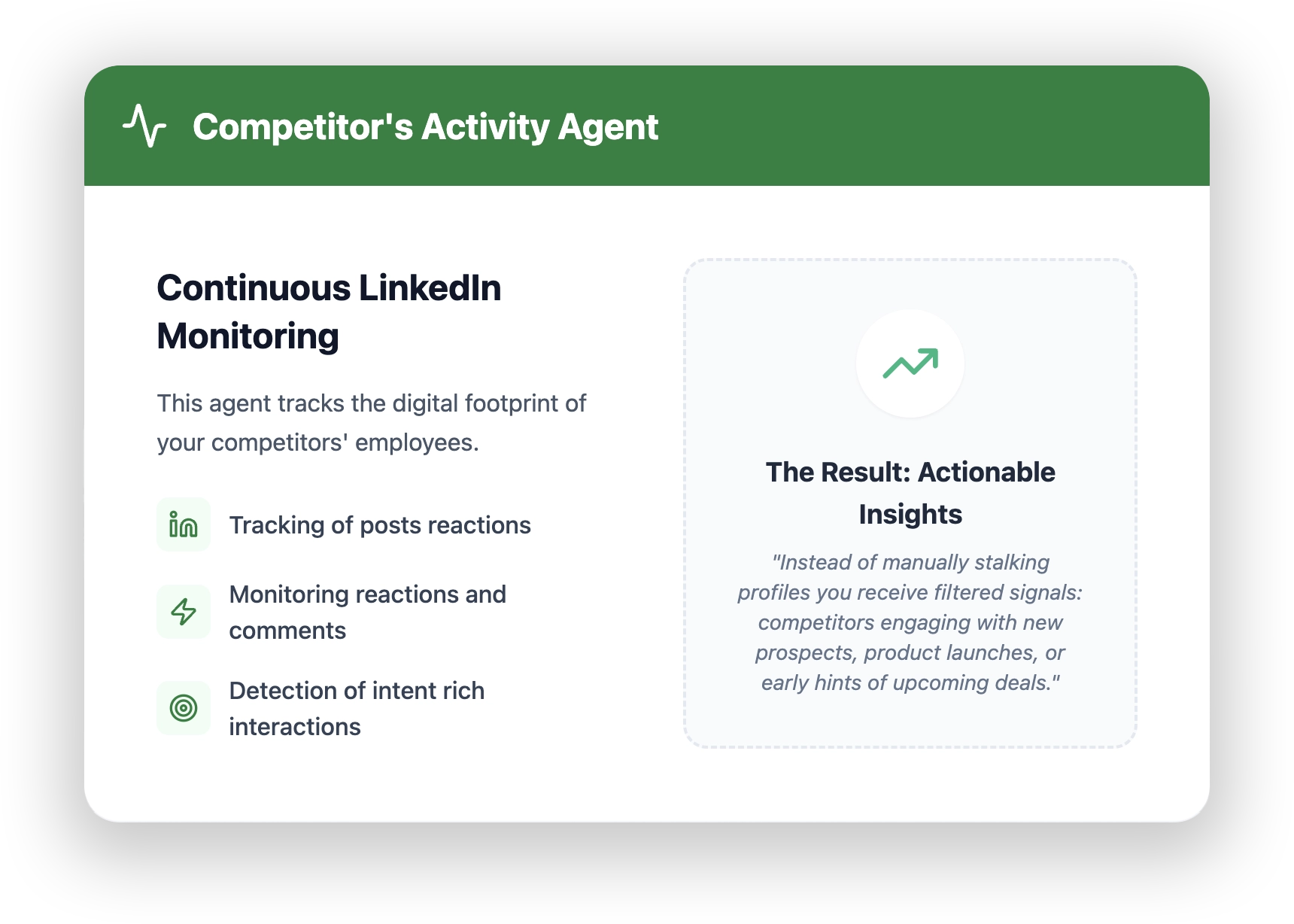
Competitor Engagement Tracking means monitoring what your competitors' employees do on LinkedIn.
Think about it. When a competitor’s account executive likes three posts from the same VP of Sales in two weeks, that's not casual scrolling - it's a sales tactic. That account is being worked. When a prospect comments on a competitor's product launch announcement, they're evaluating alternatives. They're in-market.
The signal works both ways. On one side, you track your competitors' sales reps' activity: who they're liking, commenting on, and connecting with. On the other side, you track who is engaging with your competitors' content: which prospects are reacting to their posts, sharing their announcements, or joining their conversations.
Both patterns reveal the same thing - active buying cycles that you didn't know existed.
You could try tracking this manually. But monitoring 50+ employees across 3-5 competitors, every day, across thousands of LinkedIn interactions? That's not realistic. This is where automation becomes essential.
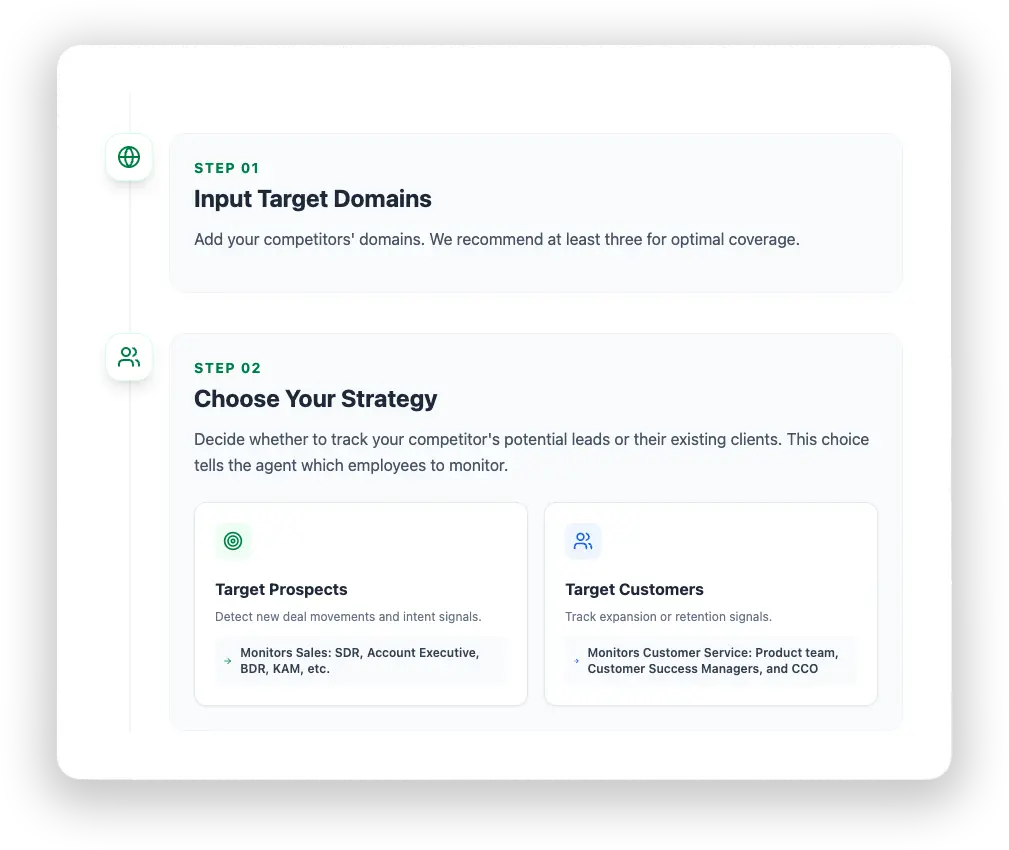
With a signal detection platform like Sillage, you simply add your competitors' domains. The platform automatically identifies their relevant employees - sales reps, BDRs, and account executives for prospecting signals, or CSMs and product teams for customer signals - and monitors their LinkedIn activity continuously. You get alerts the moment something happens, not days later.
Sillage secret sauce
Some tools allow you to scrape the engagements on a post, but there are two problems.
- You need to do it manually for each post. It’s a lot of manual work.
- You get non-ICP people in your list, say, a plumber while you sell to Chief People Officers.
Detecting competitor engagement is only the step one. The real value comes from knowing whether the person being engaged actually fits your target.
Every competitor engagement signal passes through your Personas - your Ideal Customer Profile. You only receive alerts that match your target. No noise. Only relevant signals.
Sillage signals cross-reference the data
Competitor Engagement Tracking becomes exponentially more powerful when combined with other Sillage signals:
| Agent | What it detects |
|---|---|
| Keyword Detection | Prospects mention specific keywords that matter to your business |
| Job Updates Detection | Job changes, so new decision-maker |
| Past Champion Tracking | tracks job changes of your known champions |
| Content Engagement Detection | Who interacts with content in your sector or with your content |
| Influencer Engagement Detection | Who engages with thought leaders in your market |
When several competitors start engaging with a prospect + they mention a pain point you’re solving in a LinkedIn post → you have a GOLDEN lead. You know there's interest (a competitor is actively selling), there's budget potential (new role, new initiatives), and there's fit (persona match). That's three layers of qualification before your SDR even picks up the phone.
By the way, we wrote a dedicated article on how to detect prospects mentioning their pain on LinkedIn, another powerful signal to combine with competitor tracking: LinkedIn intent data tool for B2B buying signals.
What this changes for your sales team
Imagine your SDRs tomorrow morning.
Instead of cold-messaging a static list, they receive a notification:
Your SDR has all the context for a relevant, timely message. Not "Hey Thomas, I noticed you're a VP Sales" - but a message that acknowledges what Thomas is dealing with right now, asks about his 90-day goals as the new VP Sales at CloudFlash, and discusses how your tool can help him hit them. It positions your solution as an alternative he hasn't considered yet, and arrives while the conversation is still open.
That's the difference between cold outreach and signal-based selling : Boom, meeting booked!
We have written a step-by-step guide to help you start tracking competitor activity with Sillage today:
The Complete Guide
Types of competitor signals that generate pipeline
Not all competitor engagement signals carry the same weight. Here are the patterns that consistently convert into pipeline for our clients.
The convergence signal: Multiple competitors engaging the same account within a short timeframe. When two or three vendors are circling the same prospect, there's almost certainly an active buying cycle or an RFP in the works. This is the highest-value signal you can detect - and the one that demands the fastest response.
The multi-touch prospecting signal: A competitor’s account executive likes 3+ posts from the same prospect within two weeks, then drops a comment. This isn't random networking - it's a structured warm-up sequence. That prospect is being actively worked. You need to enter the conversation now, while the evaluation window is still open.
The full-court press: A competitor's SDR likes a prospect's post, their AE drops a comment the next day, and their Head of Sales interact with the same decision-maker's content later that week. When multiple people from the same sales org coordinate around a single prospect, the prospect is being surrounded. If you're not in the picture yet, your window is closing fast.
The product launch opportunity: A competitor's AE comments on your prospect's product launch announcement - congratulating, asking questions, or offering to help scale. When a company ships something new, budgets are in motion and teams are actively looking for tools to support the next phase. If a competitor is already in their comments, they've spotted the opportunity. You should too.
Tip: start by tracking 3-5 direct competitors. Monitoring too many dilutes the signal quality and creates noise that slows your team down. You can always expand later as your workflows mature.
You can also think of other use cases to go even further than just lead generation - delivering real value like:
The churn risk alert: A competitor's CSM or product manager starts engaging with one of your customers' decision-makers on LinkedIn. This could indicate a competitive displacement play happening under your radar. Your CS team needs to know immediately - before the renewal conversation turns into a negotiation.
Your competitors are already watching yours
Here's the uncomfortable truth: if you're not tracking your competitors' LinkedIn activity, there's a good chance they're tracking yours. The highest-performing revenue teams don't rely on volume anymore - they invest in signal intelligence.
While you're reading this article, a competitor's AE might be engaging with your top prospect. A decision-maker in your ICP might be liking your competitor's latest case study. A competitor CSM might be commenting on your customer's posts. Every one of these interactions is invisible to you - unless you're actively monitoring them.
Signal-based teams act within 2 to 24 hours of a competitor engagement. That speed advantage is the difference between entering the conversation early and showing up after the deal is already half-closed.
Don't let your competitors' LinkedIn activity be a blindspot. Use buying signal solutions like Sillage to turn it into your advantage.
Book a demo
Related plays
- Real-time job change alerts software, stack competitor moves with prospect transitions.
- B2B champion tracking software, re-engage warm contacts before competitors notice.
- B2B LinkedIn social listening, broaden beyond competitors to category-level signals.
- B2B KOL tracking, find buyers in influencer audiences.