



Your best customers don't stay at the same company forever. They get promoted. They switch industries. They join startups or land VP roles at enterprise accounts. Tracking those moves is exactly what a B2B champion tracking software is built for, the highest-trust variant of the broader real-time job change alerts software category.
And when they move, they carry something incredibly valuable with them: trust in your product.
The problem? Most sales teams have no idea when a champion leaves. They find out months later, during a pipeline review, and worse - when a competitor closes the deal you weren't even there.
What if you could get alerted the moment a past champion lands a new role at a company that matches your ICP? That's exactly what Sillage's Champion Tracking agent does. And it might be the most underused, highest-ROI signal in B2B sales.
Why is tracking past champions the highest-ROI signal in B2B?
Let's start with a simple truth: selling to someone who already knows and trusts your product is fundamentally different from cold outreach.
According to the reference book “Marketing Metrics” by Farris et al., the probability of selling to an existing customer or trusted contact is 60-70%, compared to 5-20% for a new prospect. That gap is massive.
When a former champion moves to a new company, you don't just have a lead - you have an internal advocate who already experienced the value of your solution. They've seen the onboarding process, they know the ROI, and they're often looking to replicate their past success in their new role.
How to write a better outreach message to a past champion?
The best outreach messages to past champions have one thing in common: they show that you understand the person on the other side. Not their job title, not their company size - but their actual situation. Someone who just changed jobs is navigating a new team, new expectations, and the pressure to deliver results fast. If your message speaks to that reality, it doesn't feel like sales. It feels like someone who gets it.
That's the real difference between a cold email and a champion re-engagement message. A cold email tries to create interest from scratch. A champion message builds on a shared understanding that already exists - you know what they care about, what they've achieved, and what challenges they're likely facing again.
Think about the difference between these two outreach messages:
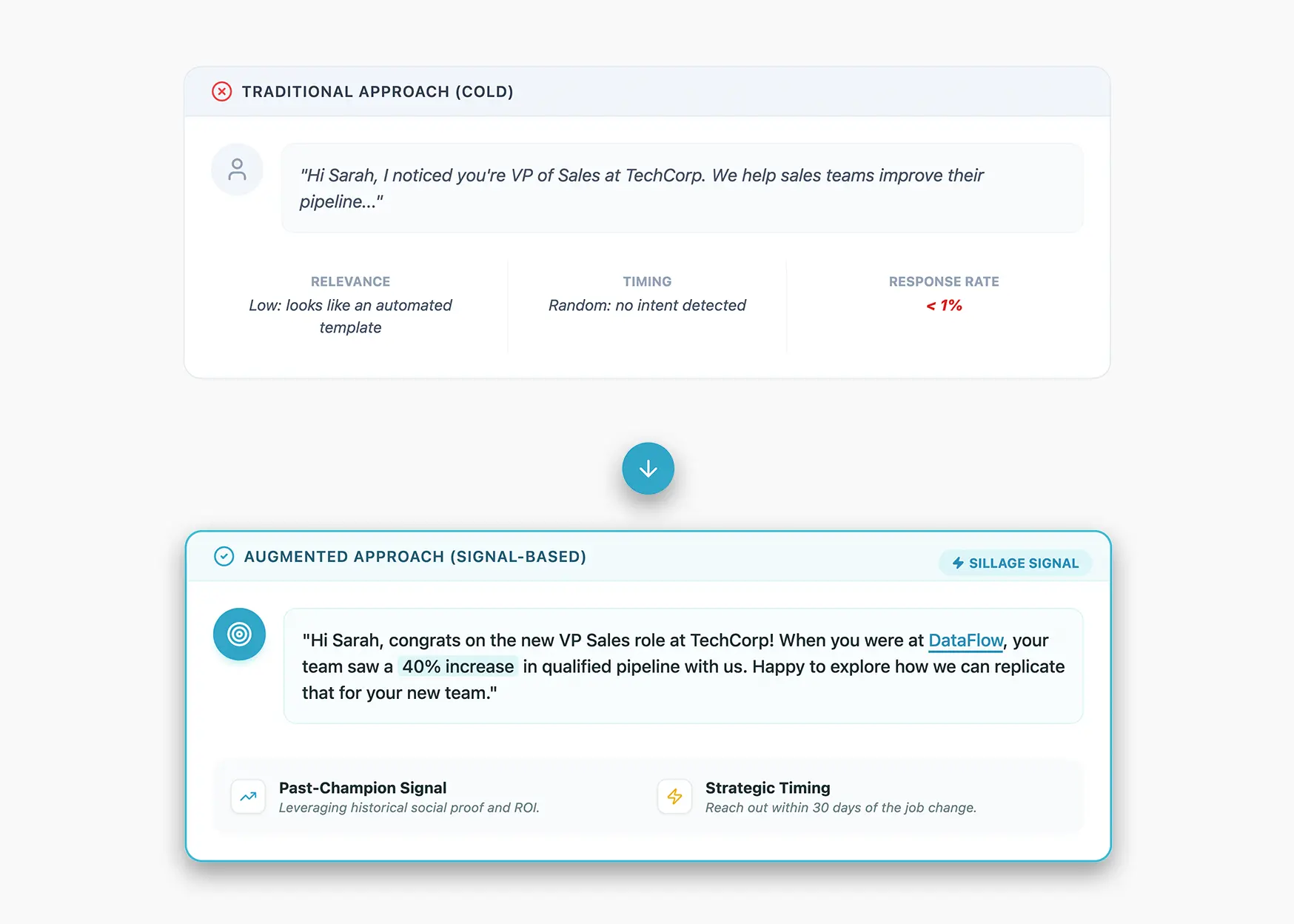
The second message doesn't feel like a sales pitch. It feels like a relationship being rekindled. That's the champion advantage - you're not starting from zero. You're picking up where you left off.
When is the best time to reach out to a champion who changed jobs?
You have roughly 90 days. During the first three months in a new role, decision-makers have budget to spend, mandates to deliver results, and the autonomy to bring in tools they trust. They're evaluating vendors, setting up processes, and making buying decisions.
After that window closes, inertia kicks in. They've committed to a tech stack, allocated budgets, and moved on to execution. If you detect the job change three months late, you've likely missed the opportunity.
How to track your champions' job changes and create pipeline automatically
Champion Tracking means continuously monitoring the career moves of people who already know and love your product - past customers, power users, executive sponsors, and key stakeholders. The goal is simple: detect when one of them changes companies, and check whether their new company fits your Ideal Customer Profile. Where they land on the account's power mapping decides whether it is a warm re-entry or a cold start.
In practice, doing this manually is nearly impossible. It would mean exporting your CRM contacts, checking LinkedIn profiles every week, and cross-referencing each job change with your ICP criteria. For a list of 200+ champions across your customer base, that's not a weekly task - it's a full-time job, and by the time you notice a change, the decision window has likely closed.
For this, an AI agent can automate the entire process: monitor your champion list continuously, detect job changes in real time, filter them through your ICP, and alert your team only when there's a qualified match. No manual checks, no missed signals.
With platforms like Sillage, you can create and configure this type of agent in minutes. You upload a list of your champions (via CSV, XLSX, or by adding LinkedIn profile URLs manually), define your ICP criteria, and the agent takes it from there, then alerting you the moment a match happens with all the context you need: new company, new role, timing, and account fit.
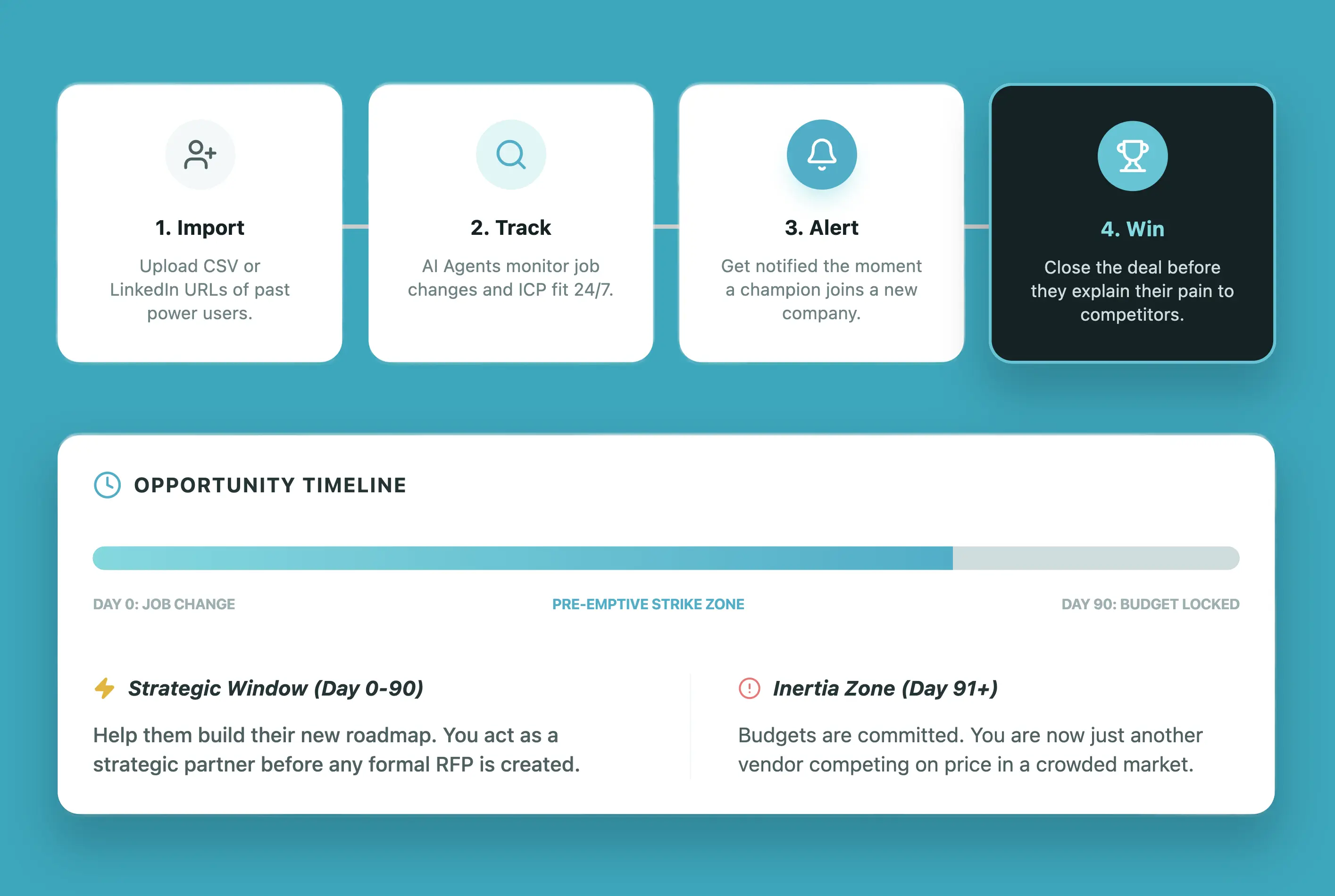
Tip: start by uploading your top 50-100 champions - the ones who were most engaged, most vocal about your product, and held the most influence. You can always expand the list later, but starting focused ensures the highest signal quality.
How to know the full context of a lead before reaching out?
Knowing that a champion changed jobs is valuable, but it's only one piece of the puzzle. The real question is: should you reach out, and with what angle? That depends on context - and context comes from combining multiple data points.
The first layer is ICP qualification. A job change alone doesn't tell you whether the new company fits your target market. Some CRM tools can flag when a contact's company changes, but CRM data is often outdated, and a raw job change notification gives you no indication of account fit. With Sillage, every job change signal passes through your Personas (your Ideal Customer Profile) defined by role, seniority, company size, industry, and location. You only receive alerts when a champion moves to a company that actually matters.
The second layer is cross-referencing with other buying signals. A champion landing at an ICP-matching company is a strong signal. But if that same company is also being prospected by a competitor, or if someone there recently posted about a problem your product solves, you're looking at a completely different level of urgency. That's what signal cross-referencing enables - building a full picture of the opportunity before your rep picks up the phone.
Here are the types of signals you can combine with Champion Tracking:
| Agent | What it detects |
|---|---|
| Keyword Detection | Prospects mention specific keywords that matter to your business |
| Competitor's Activity | What your competitors' employees are doing on LinkedIn |
| Job Updates Detection | Job changes, so new decision-maker |
| Content Engagement Detection | Who interacts with content in your sector or with your content |
| Influencer Engagement Detection | Who engages with thought leaders in your market |
When a past champion changes jobs + their new company is being prospected by a competitor + they match your persona → you have a GOLDEN lead. You have trust (the champion already knows you), urgency (a competitor is circling), and fit (ICP match). That's triple qualification before your rep even picks up the phone.
We also wrote a dedicated article on how to detect your competitors' interactions with your prospects on LinkedIn - so you never miss an opportunity they're already working on: Competitor Activity: Turn your competitors' LinkedIn activity into pipeline.
What this changes for your sales team
Imagine your AEs tomorrow morning.
Instead of reviewing a stale pipeline, they receive a notification:
Sarah, your former champion at DataFlow, just joined TechCorp as VP of Revenue Operations.
Sarah led the rollout of your platform at DataFlow for 18 months.
TechCorp matches your ICP: it’s a match!
Your AE has all the context for a warm, relevant message. Not a generic "congratulations on the new role" - but a message that references the shared history, acknowledges what Sarah achieved with your product, and opens the door for a new conversation. It arrives while Sarah is still building her new stack, evaluating tools, and looking for quick wins to prove herself in the first 90 days.
That's the difference between cold outreach and signal-based selling: you're not interrupting someone's day. You're showing up at the exact moment they're most likely to say yes.
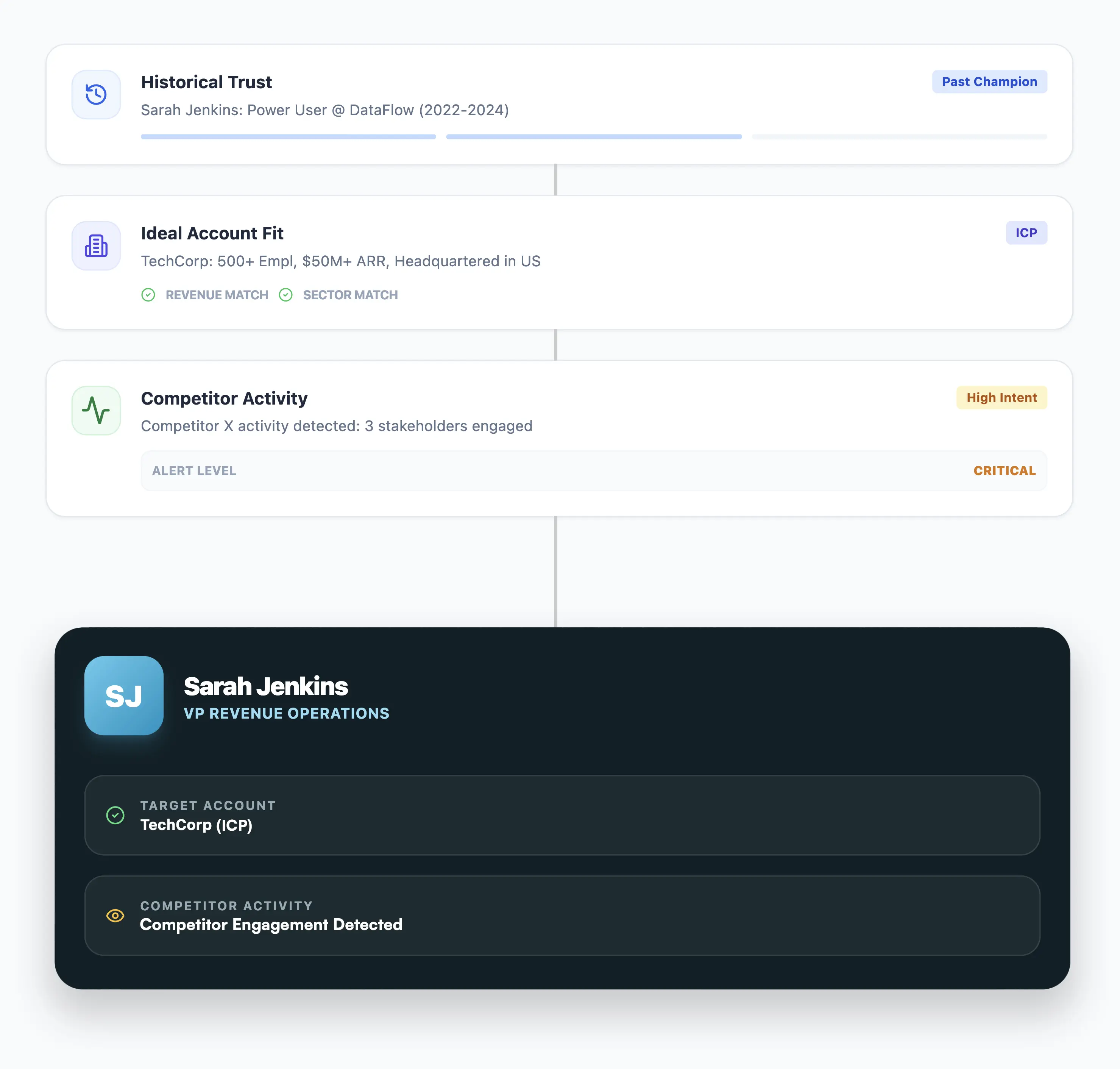
We have written a step-by-step guide to help you start tracking your past champions with Sillage today:
The Complete Guide
Your past champions are moving right now
Here's the reality most sales teams ignore: your best advocates are changing jobs every 2-3 years. The average tenure for a B2B decision-maker is shrinking. Every time a champion moves, there's a window of opportunity - and a risk that a competitor gets there first.
While you're reading this article, a former champion might be starting their first week at a company that perfectly matches your ICP. They might be evaluating tools this very moment, wishing they could bring in the solution they trusted at their last company. But if nobody from your team reaches out, they'll default to whatever the new company is already using - or worse, whatever a competitor pitches first.
Signal-based teams act within days of a champion's job change. That speed advantage is the difference between rekindling a trusted relationship and watching a competitor close a deal that should have been yours.
Don't let your best relationships go to waste. Use buying signal solutions like Sillage to track your past champions and turn every job change into pipeline.
Book a demo
Related plays
- Real-time job change alerts software, the broader category and how to set it up.
- B2B LinkedIn social listening, surface category-level intent beyond named contacts.
- B2B LinkedIn competitor monitoring tool, detect when a competitor's rep starts engaging the same account your former champion just joined.
- How signal intelligence is changing prospecting, the broader strategy.