


I'm CTPO at Sillage, a seven-person startup. Three of us write code, and we don't build features without agents anymore: each one goes through a fixed pipeline of subagents, defined in markdown files in one Git repo. Today the harness that runs them is Claude Code, but the setup is built so we can swap it, and we regularly try others. This is a write-up of how that pipeline works today, how the rest of the team plugs into it, what runs while nobody is watching, and what still breaks. I described an earlier version on the AI Club podcast (in French) in July. With how fast coding agents and our own habits have moved since, a lot has changed; this post describes where our tech team stands today. I'm sharing it in the hope that it gives other teams a few ideas, and that teams who went through the same steps send theirs back.
Nothing here is a product. It's a folder of prompts, a few shell scripts, and conventions we got burned into.
The constraint we optimize for
The scarce resource on a three-person team is not model capacity. It's our attention. The harness will happily run a dozen subagents in parallel; I lose the thread somewhere around five. Every context switch costs more than the review it was for.
The second problem was variance. When the prompt doesn't name the next step, the agent, the tool or the MCP server to use, the model fills the gap, and it fills it differently every session. Same request on Monday and Tuesday, two different approaches.
So the design goal of the pipeline is boring: make every run follow the same sequence, and spend human attention only where a diff actually needs it.
One repo for the whole team
Everything lives in one repo that every person on the team clones, sales and customer success included. Each of them runs their own harness instance on top of it:
.claude/
  agents/            # 22 subagent definitions (one .md each)
  skills/            # 92 skills, each a folder with SKILL.md + rules/
discoveries/         # one report per feature (written by an agent)
visions/             # one per feature
plans/               # one per feature
briefs/              # autopilot runs
audits/              # end-of-stack DB audits
Adding a skill or an agent is a pull request on that repo, reviewed like code. Each person's harness keeps its own memory for personal preferences; anything about the company lives in the repo. The rule started on the tech side, because we didn't want each developer's agent to code its own way, and spread from there.
The payoff came from outside engineering. One of our SDRs wanted help with images for her posts and built an agent for it, which later grew into a motion design agent. The day it was merged, the whole team had it. Nobody builds tools in a corner anymore. The same goes for work in progress: before starting a task, an agent searches our Linear for a ticket on the same subject, and if someone is already on it, it stops and says so. Every change has a ticket, created by the agent when none exists.
We also hold a weekly meeting about agents, next to the product, tech and go-to-market ones: thirty to forty-five minutes where anyone brings an idea and the tech side says what's doable. Ideas from people far from code are sometimes odd and sometimes the best of the week. It took weeks, for some people months, before it clicked. Now the problem is limiting what gets added, not motivating people to add things (more on that in the last section).
A subagent is a markdown file with frontmatter. This is the whole header of one of the reviewers:
name: security-reviewer
description: >
  Reviews the changed lines of a diff for security only: tenant isolation,
  authentication, input and output boundaries, web and Node.js attack classes.
  Read-only. Spawned in parallel with architecture-reviewer and
  specification-reviewer by the code-reviewer skill.
model: sonnet
tools: Read, Glob, Grep, Bash
skills:
  - security-review
The body is a short "soul" (who it is, how it talks, what it never does) and a list of non-negotiables. It's still a little strange that this is how you program behavior now.
The sequence
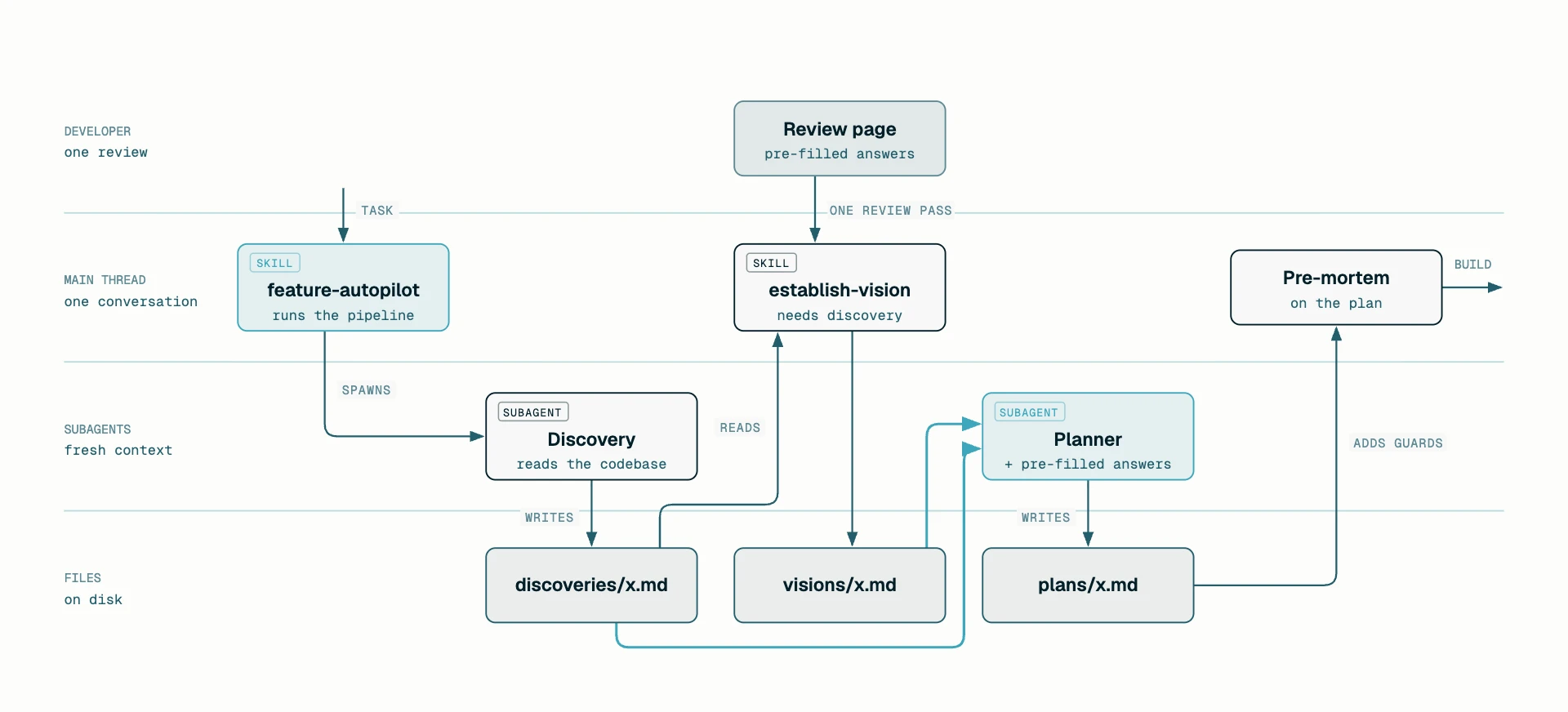
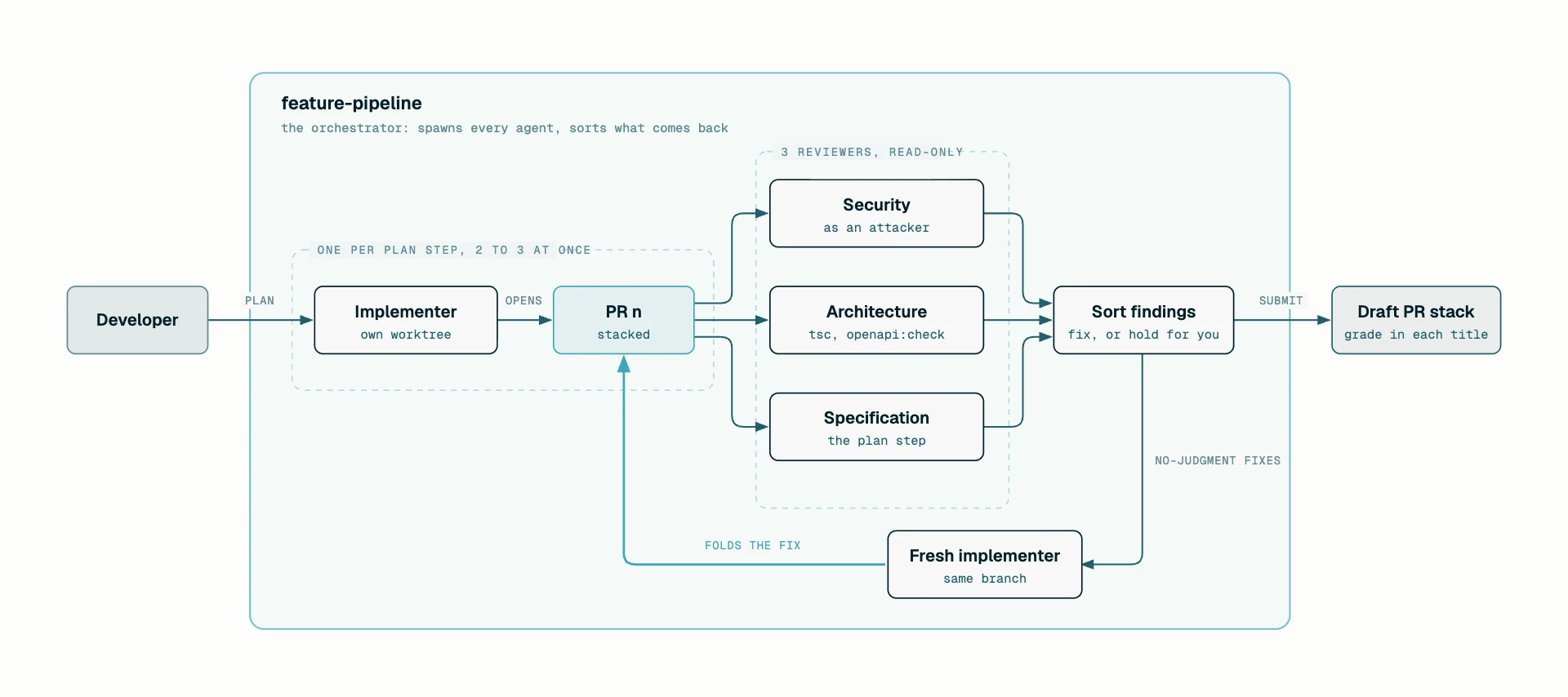
One skill, feature-pipeline, owns the order. Its description is what makes the agent load it whenever someone asks to plan or build anything, so nobody invokes it by hand:
- Discovery (subagent)
- Vision (in the main thread)
- Plan (subagent)
- Pre-mortem (main thread)
- Parallel implementation, one subagent per PR, each in its own git worktree
- Three reviewers per PR, in parallel
- End-of-stack DB audit and resilience check, in parallel
- Verification: a checker on an isolated environment, plus a test writer
- One final summary
The interesting decisions are mostly about which stages are subagents and which aren't.
Discovery is a subagent because reading is expensive
Discovery reads the codebase and writes discoveries/<feature>.md: every model, route, service and screen the feature touches, what already exists, where a change could regress. On the run I demoed in July it was 230 lines. It's a subagent only to keep a few hundred file reads out of the main context.
Vision is not a subagent, on purpose
A subagent doesn't see the conversation. It gets the prompt the parent writes for it, which is a summary. The vision is where the developer's intent lives, so it runs in-thread as a skill and keeps the raw words.
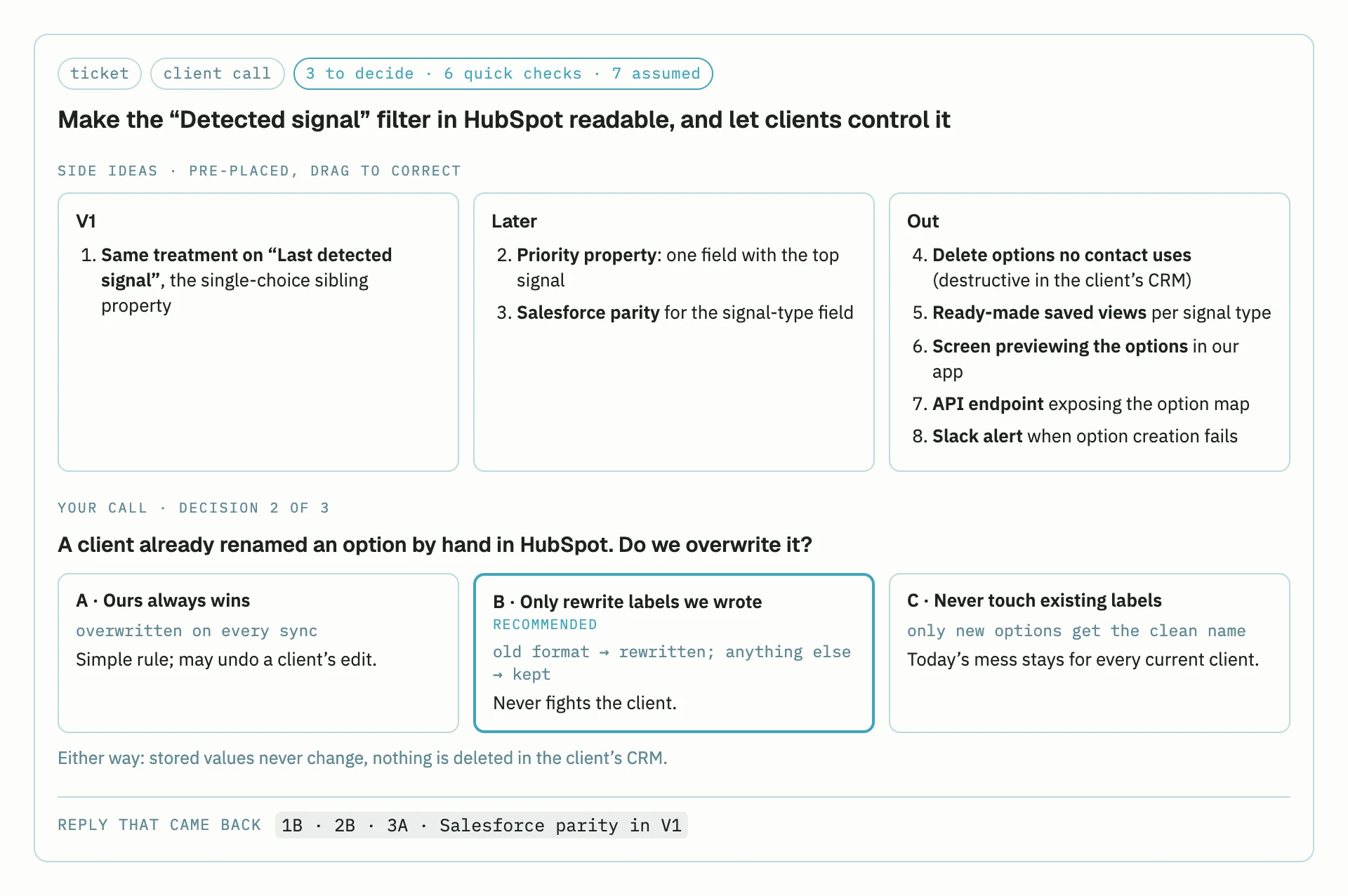
It asks the usual scoping questions (6 months, 18 months, in, out). The one question that changed how we work: it lists about ten adjacent features it thinks the request implies, and asks for each one whether it's V1, later, or out of scope. They land pre-placed on a small board with three columns, and the developer drags the ones that are misplaced (there's a real one further down). Half the value is the "out of scope" column, which goes into the vision file so the implementers don't build it.
The planner gets a clean context, on purpose too
The planner is a subagent that receives two files, the discovery and the vision, plus a block of interview answers the autopilot pre-fills from them (more on the autopilot below). It never sees the conversation: we don't want it reading the back-and-forth that produced those files. It writes plans/<feature>.md, one step per pull request, with the files, the checks to run and the tests to keep. The July demo: 484 lines, 9 steps.
Pre-mortem
Before any implementer starts, the main thread asks the plan one question: "if this breaks in three months, what's the most likely reason?" It walks a fixed list (10× volume, an upstream field changing shape, an assumption only true today, retries and duplicates, two workers at once, an uncapped cost, another reader of the same table) and keeps at most five failure modes, each with a trigger, a location, the cheapest guard and how we'd notice. "Silently" is a valid and bad answer. Guards go into the plan. The same question runs again on the finished stack.
Who answers the questions
The original version of this asked the developer everything: four or five waves of vision questions, then the planner's interview, then every "should I…?" during the build. That was the main source of context switches.
Since September, an autopilot skill sits on top of the pipeline. The vision still belongs to the developer, but it arrives pre-filled with proposed answers and their sources, and gets one review pass on a page that sorts items into "decide", "quick check" and "settled". After that, a product-lead agent answers forks itself, from four sources in fixed order: the developer's brief, a file of written product priors, decision logs from past visions, and a default policy.
Here is what that review page looks like, on a recent feature for our HubSpot sync. It shows decisions and their evidence; the reasoning stays in the vision file the planner reads. Only the red cards need an answer, the yellow lines count as "ok" unless corrected, and the settled ones are folded away. The developer presses one button and pastes a single line back into the conversation.
The policy is three tiers:
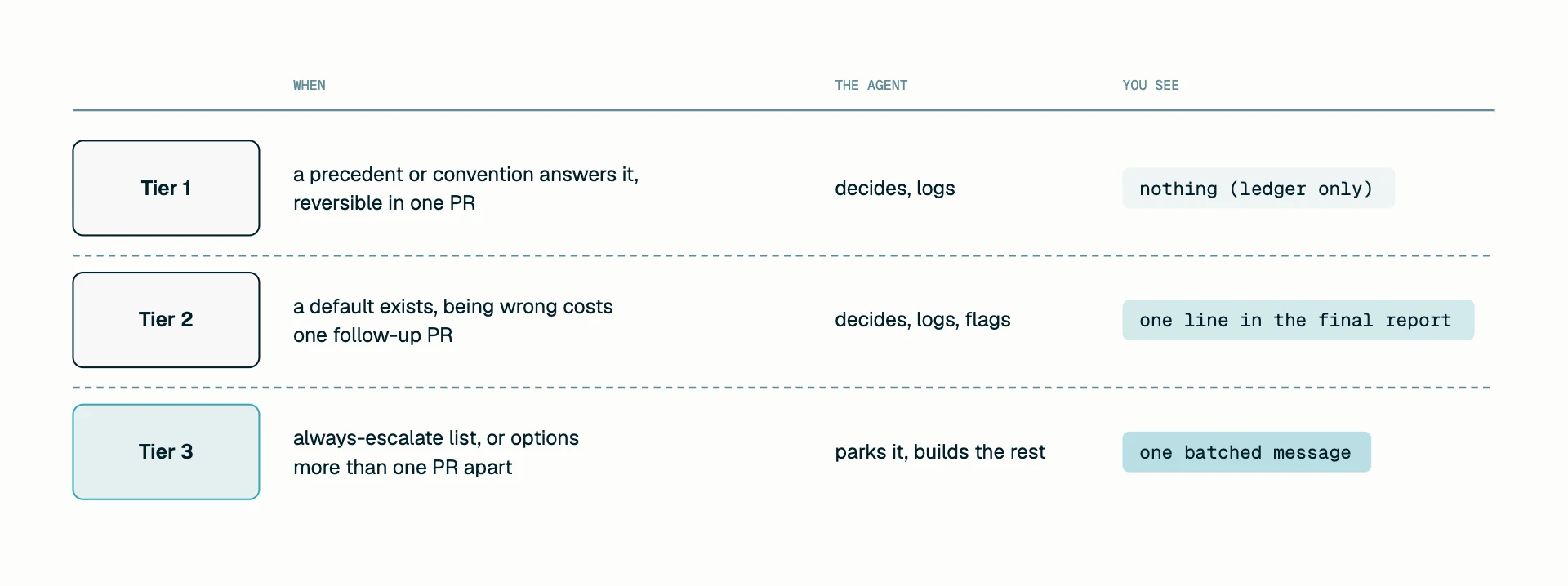
The always-escalate list is the part that makes it safe enough: destructive data operations, anything touching money or credits, breaking changes to a public contract, auth and secrets, creating a new table, anything customer-facing outside the product, and anything that runs against production. The autopilot ends at opening the PRs. Merging is ours.
Every decision, any tier, becomes one line in a ledger with its source. When a call looks wrong, the ledger says which source it came from, so we fix the source rather than the run. We have 101 autopilot briefs on disk.
Building in parallel
Each plan step is one PR, built by a fresh implementer subagent in its own worktree (a small create-worktree.sh does it, and a check-worktree.sh gate checks the git state after each agent returns, because agents are creative with git). Back end and front end run at the same time. The PRs are stacked with Graphite.
Stacking is old advice (small changes review better), but it got a new reason: the PR is the unit we grade. So the plan slices for risk, not for size. The migration, the money write or the auth change goes in its own smallest PR. Logic behind a flag set to off goes in another. One red PR and four green ones beat one orange monolith.
Three reviewers instead of one
We had one review subagent until October. The bet behind splitting it: one prompt that has to care about injection, duplication and business edge cases at once cares about none of them very hard.
Now each PR gets three read-only reviewers in parallel, each forbidden from commenting outside its perimeter:
- security reads as an attacker: whose workspace does this id belong to, who proved they're allowed, where does this string end up. Severity must follow an exploit path it can show in the diff.
- architecture reads as next year's maintainer: does this logic exist elsewhere, which module owns it, what will the next change touch. It also runs
tscand our OpenAPI check and reports each command. It's told never to ask for an abstraction with one call site. - specification reads with the plan step open: is what the step asks there, no less, no more, and what happens on the second click, the empty list, the trial workspace, the feature next door that reads the same table.
Each returns findings with file:line, severity and a concrete fix, then a fixed footer:
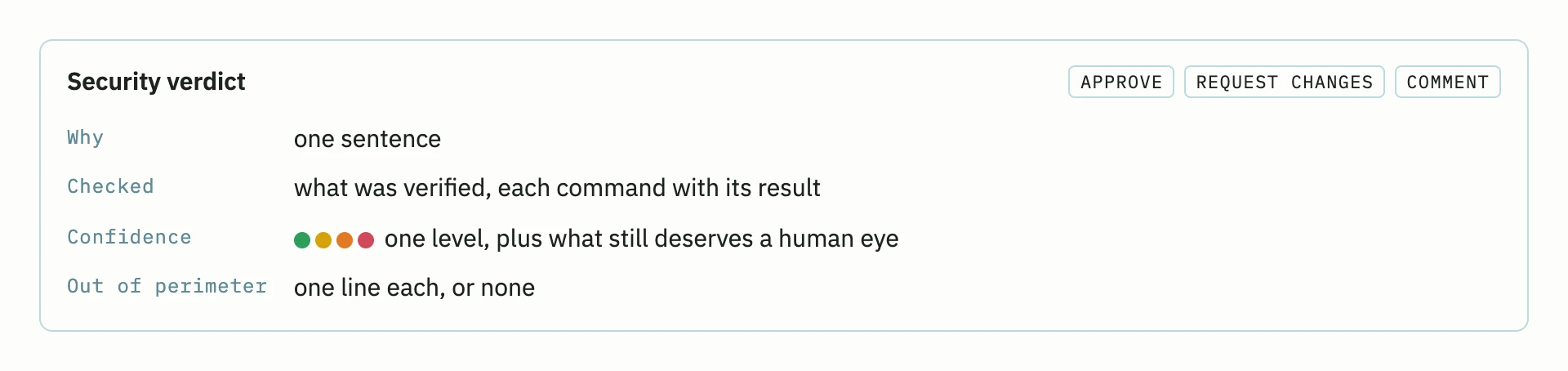
The Checked: line is there so an approval has to say what it actually verified.
A grade instead of a review queue
The Confidence: lines feed a grade the orchestrator puts in every PR title. Five criteria: blast radius, reversibility, proof (did the risky part actually run), the three reviewers, and other open PRs on the same files. No scoring: the PR is worth its worst line. A billing migration with perfect tests is still red.
🟢 means merge, 🟡 means read the parts the table names, 🟠 means read the whole diff, 🔴 means read it and test by hand.
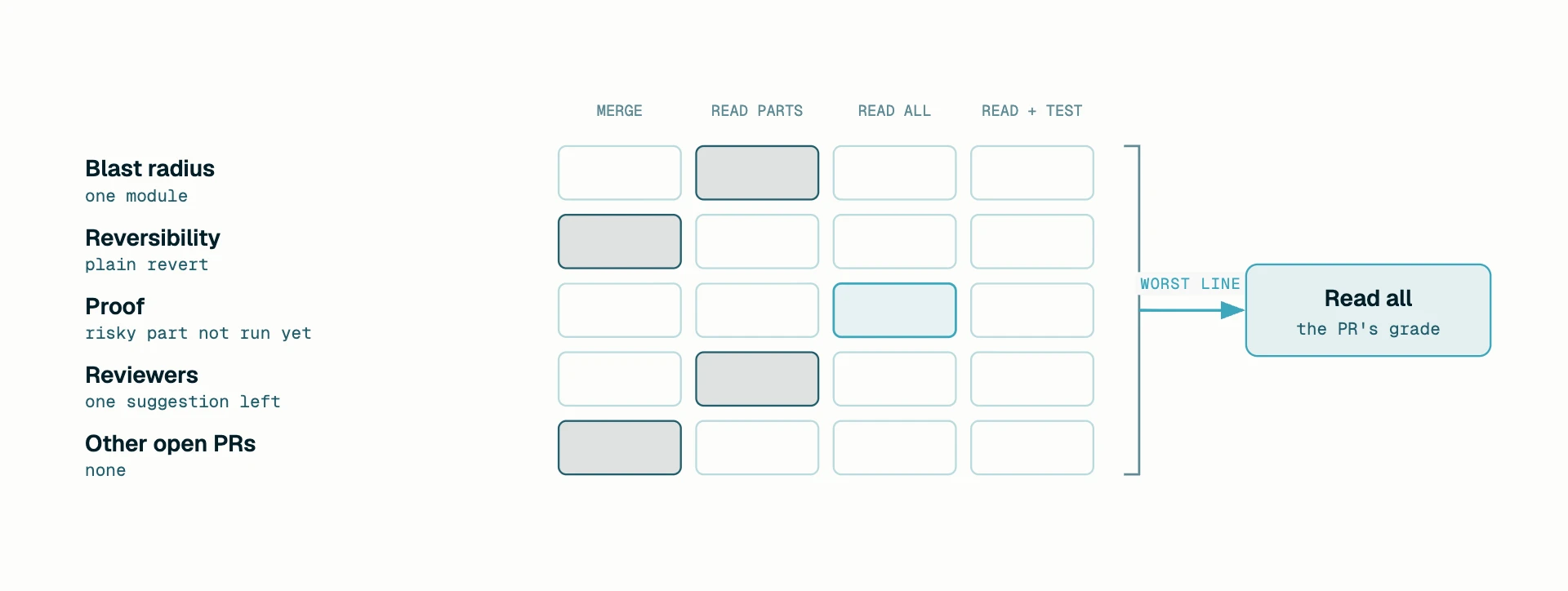
From October 9 to November 23, PR titles across our two main repos carried 357 🟢, 331 🟡, 509 🟠 and 154 🔴. So most PRs still need a real read. That's fine; the grade doesn't make PRs safer, it tells us which ones aren't.
Verification and the tests we keep
Two agents, two jobs. The checker verifies a feature once, on a "slot": the whole stack booted from the top of the PR stack, on its own ports, with its own job queue and a clone of the database. It signs in as a test user, clicks through every touched screen with video on, compares each one with the ticket or mockup, and reads the database after each action. Paid vendors are blocked at first, then called on the cheapest entities that exercise the same code, within a budget the developer approves above five dollars. Gaps go back to a fresh implementer, three rounds at most. What it can't check lands in a short "left to you" list: production-only data, real waiting time, UX judgement.
The test writer writes the tests we keep, and the default is none. A test is committed only if someone can finish this sentence with a real customer loss:
If this breaks silently, the customer loses money or data, or sees another workspace's data, because …
Zero kept tests for a feature is the normal result.
How the slots are isolated, how the vendor budget works, the fix loop and the review page that comes out of it get their own post, Agents that test their own work, coming later.
The end-of-stack audit
One agent reads the finished stack, never individual PRs, looking for DB round trips that can be merged and dead code left behind when a later PR changed the plan of an earlier one. Only the whole stack shows that. Findings come stamped AUTO (high impact, verified zero risk, capped at five, applied by a fresh implementer and typechecked) or ASK (a human call). An AUTO fix that fails typecheck or conflicts is reverted and becomes a question, never retried. 108 of those audits so far.
Things that run without us
The pipeline starts when someone types. Two routines start on a clock:
- 06:00, weekdays, the code-review stand-up bot: it scans every open PR in the org, rebuilds the stacks and posts one line per stack in Slack, oldest first, with a thread of who is blocking what. Stacks with an agent-written PR get their own section.
- 05:00, production errors: a pass reads prod errors and tries fixes before anyone reports them, with the same
[AI-WRITTEN]prefix. From July 1 to November 23 it opened 67 PRs: 58 merged, 5 closed, 4 open. Merged doesn't mean untouched.
The lesson from these was about ownership, not prompts. A scheduled routine in a harness lives in one person's account: its prompt sits in their app, and the week they're off, nobody can restart it. So the prompt of every routine says almost nothing. It points at the shared repo and tells the agent to read its real instructions there, like every other agent. That still left them tied to someone's account, so we set up a Hermes agent to run them instead: most of our routines and crons now run on our assistant on a server, not in anyone's account (more on it in the next section).
Not tied to one harness
Today the harness is Claude Code, and the definitions follow its format. We don't want the pipeline to depend on that, for two reasons: other harnesses keep getting better, and today's pricing for heavy use won't last forever.
So the agents and skills stay canonical in one folder, and a second folder (.agents/) holds only adapters, output contracts and team definitions: which runtime runs which agent, and what it must return. Another runtime reads the latest canonical file before running an agent. We try other harnesses regularly this way (OpenCode, for example), and if one of them does this better, we switch.
That assistant is our first runtime outside Claude Code: Hermes, an open-source agent framework, running on a small VPS (about 25 euros a month). It talks to us on Slack and Telegram, it runs most of our routines, from the production-error pass to our Monday content radar, and it can hand bounded coding steps to another model. Putting it on a server instead of a laptop also settled the security question: its rights are whatever the server and its tokens allow, nothing more.
What doesn't work yet
- Context weight. Everyone contributing has a cost: 52 skills in July, 92 now, and a new teammate's first PR to the repo was 3,500 lines of skills. Every description loads into every session, used or not. The next step is per-role skill sets; not done.
- Latency. A large stack runs for over an hour. We stopped watching it; we didn't make it faster.
- Attention. Most PRs are orange. The pipeline moved our time from writing to reviewing and deciding, which is the right direction, but the review load is real.
- Harness glue. The definitions follow Claude Code's format today (frontmatter fields, how skills and subagents load). The adapter folder translates them for the other harnesses we try, but each one still needs some glue, and behavior is never quite identical.
For scale: a large feature took us about five days in July, against roughly six weeks before we worked this way. Small fixes take a couple of hours. I'd expect most of this post to be out of date in three months; the July version was.
Thanks to Alexandre Larose and Jérémie Gauthier, who designed a large part of this pipeline with me.